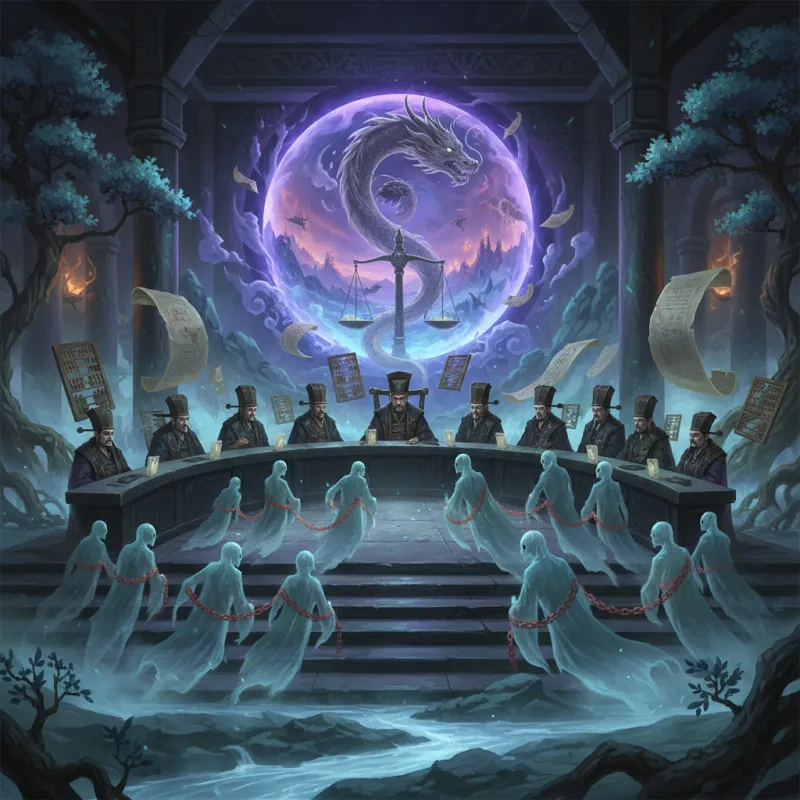
When you die in China, you don't meet Saint Peter at the pearly gates. You meet King Qinguang (秦广王, Qín Guǎng Wáng), and he's holding a ledger with every lie you've ever told, every bribe you've taken, every time you cut in line at the dumpling shop. Chinese hell isn't about eternal damnation — it's about bureaucratic processing. You're not damned forever; you're just... detained for processing.
The Machinery of Cosmic Justice
The Chinese underworld operates on a principle that would make any civil servant proud: proportional punishment, meticulous record-keeping, and eventual rehabilitation. This is Diyu (地狱, dìyù), literally "earth prison," and it functions less like Dante's Inferno and more like a particularly harsh DMV where the wait times are measured in years and the penalties involve having your tongue ripped out.
The system crystallized during the Tang Dynasty (618-907 CE), though its roots stretch back to Buddhist sutras imported from India and indigenous Daoist concepts of cosmic balance. By the time the Ming Dynasty novel Journey to the West was putting finishing touches on popular mythology, the Ten Courts of Hell were as fixed in the Chinese imagination as the Great Wall itself. Each court specializes in particular sins, each king has jurisdiction over specific moral failures, and every soul gets its day in court — ten of them, actually.
What makes this system fascinating isn't its cruelty (though we'll get to that). It's the underlying assumption: you can work off your debt. Punishment is corrective, not vindictive. Even the worst sinner eventually gets reincarnated, though they might come back as a hungry ghost or a dung beetle depending on how the appeals process goes.
The Ten Kings and Their Terrible Jurisdictions
First Court — King Qinguang (秦广王, Qín Guǎng Wáng): Every soul's first stop. This is intake, where your life gets reviewed like a suspicious tax return. King Qinguang sits before the Mirror of Retribution (孽镜台, Niè Jìng Tái), which reflects every deed you committed in life — no appeals, no excuses, no "but I was drunk." The truly virtuous skip the remaining courts entirely and head straight to reincarnation or the Western Paradise. Everyone else gets assigned to the appropriate specialist court. Think of him as hell's triage nurse, except instead of checking your blood pressure, he's checking whether you beat your parents.
Second Court — King Chujiang (楚江王, Chǔ Jiāng Wáng): Corruption, fraud, medical malpractice, and abuse of authority. This king particularly despises doctors who let patients die through negligence and officials who took bribes. The punishments here involve freezing — souls are thrown into pools of ice or chained to frozen pillars. In traditional Chinese medicine, cold represents stagnation and blockage, so there's a poetic logic to freezing those who blocked justice or the flow of proper treatment.
Third Court — King Songdi (宋帝王, Sòng Dì Wáng): Ingratitude, disrespect to elders, and tax evasion. Yes, tax evasion gets you sent to hell in Chinese cosmology — the bureaucracy extends beyond death. Punishments include having your heart cut out (for the ungrateful) and having your knees crushed (for those who wouldn't kneel to their parents). The Chinese obsession with filial piety isn't just cultural preference; it's cosmically enforced.
Fourth Court — King Wuguan (五官王, Wǔ Guān Wáng): Misers, tax dodgers (again — they really care about taxes), and those who shirked their social duties. This court also handles people who wasted food, which makes sense in a civilization that spent millennia one bad harvest away from famine. The punishments involve being ground between millstones or having heavy stones placed on your chest until you understand the weight of your obligations.
Fifth Court — King Yanluo (阎罗王, Yán Luó Wáng): The big one. King Yanluo — known in Sanskrit as Yama — is the most famous of the ten kings, often mistakenly thought to be the sole ruler of the Chinese underworld. He judges murder, atheism (a relatively late addition), and unnatural deaths. His court contains the massive ledgers of life and death, and he commands the largest staff of demon bureaucrats. This is where souls face their most severe judgments, and where the punishments get genuinely creative: being sawed in half, having your intestines pulled out, being crushed under mountains.
Sixth Court — King Biancheng (卞城王, Biàn Chéng Wáng): Blasphemy, desecration of sacred texts, and crimes against religion. Also handles people who complained too much about their fate — apparently cosmic whining is a punishable offense. Punishments include being thrown into a forest of knife-trees or being forced to climb mountains of razors. The message is clear: respect the cosmic order, or the cosmic order will shred you.
Seventh Court — King Taishan (泰山王, Tài Shān Wáng): Grave robbery, body desecration, and selling or eating human flesh. Named after Mount Tai, one of China's most sacred mountains, this king takes violations of the body's sanctity seriously. Punishments involve being boiled in oil, having your body dismembered repeatedly, or being fed to dogs. The court also handles people who sold or consumed dog meat, which adds an ironic twist to that last punishment.
Eighth Court — King Dushi (都市王, Dū Shì Wáng): Filial impiety (yes, another court for this — it's that important), harming family members, and causing others to suffer through your actions. This court specializes in punishments that mirror the crime: if you starved your parents, you'll be starved; if you beat your children, you'll be beaten. The principle of karmic reflection reaches its purest form here.
Ninth Court — King Pingdeng (平等王, Píng Děng Wáng): His name literally means "King of Equality," and he handles prostitution, pornography, and sexual crimes. Also judges people who accidentally caused harm through negligence. The punishments involve being crushed by boulders, thrown into pits of wasps, or having your body torn apart by hooks. Despite his name suggesting fairness, this court shows no mercy to those who violated sexual propriety.
Tenth Court — King Zhuanlun (转轮王, Zhuǎn Lún Wáng): The exit interview. King Zhuanlun, the "Wheel-Turning King," determines your next incarnation based on your performance in the previous nine courts. This is where you drink the Tea of Forgetfulness (孟婆汤, Mèng Pó Tāng), administered by the goddess Meng Po, which erases your memory of hell and your previous life. Then you're assigned your next body: human, animal, hungry ghost, or if you really screwed up, you might be sent back through the courts for another round.
The Bureaucratic Logic of Suffering
What strikes modern readers about this system isn't the torture — medieval Europe had plenty of that in its hell imagery. It's the organization. Chinese hell runs on paperwork. There are registers, ledgers, case files, and appeals processes. The demon guards aren't chaotic monsters; they're civil servants with specific job descriptions. Ox-Head (牛头, Niú Tóu) and Horse-Face (马面, Mǎ Miàn), the most famous demon guards, are essentially bailiffs who escort souls between courts.
This reflects something deep in Chinese civilization: the belief that cosmic justice operates like earthly justice, only more efficiently. The emperors claimed to rule by the Mandate of Heaven (天命, Tiān Mìng), and the underworld kings operate under the same principle. They're not arbitrary demons; they're appointed officials carrying out cosmic law.
The system also reveals Chinese pragmatism about human nature. Unlike Christian hell, where sins are often categorized by their offense to God, Chinese hell categorizes sins by their social impact. Murder is bad, yes, but so is being ungrateful to your parents, cheating on your taxes, or wasting rice. The underworld enforces social harmony as much as moral purity.
The Escape Clauses
Here's where it gets interesting: you can game the system. Not through loopholes exactly, but through proper religious observance. Buddhist and Daoist rituals performed by living relatives can reduce your sentence. Burning paper money and offerings provides you with resources in the underworld — yes, you can literally bribe your way to better treatment, even in hell. The seventh day after death, the forty-ninth day, and various anniversaries are crucial moments when the living can intervene on behalf of the dead.
Some souls get VIP treatment. Monks, nuns, and the genuinely virtuous might skip the courts entirely. Others might have their sentences commuted through the intervention of bodhisattvas like Dizang (地藏, Dì Zàng), who made a vow to empty hell of all souls. It's a system with both strict rules and divine mercy, punishment and redemption.
The most famous escape route appears in Journey to the West, when Monkey King storms the underworld and erases his name (and the names of all monkeys) from the registers of death. It's played for comedy, but it reveals something true about the system: it runs on records, and records can be altered. The bureaucracy is powerful, but not omnipotent.
Why This Hell Still Matters
Walk into any traditional Chinese temple, and you'll likely find paintings or sculptures depicting the Ten Courts. They're not subtle — the tortures are rendered in vivid, gruesome detail. These aren't meant to be abstract theological concepts; they're meant to scare you straight. The message is clear: actions have consequences, and those consequences are both specific and inevitable.
But there's something almost comforting about this hell compared to eternal damnation. You're not damned forever; you're just... paying your debt. The system is harsh but comprehensible. Follow the rules, honor your parents, pay your taxes, don't murder anyone, and you'll get through processing relatively quickly. Screw up, and you'll spend a few centuries getting your tongue ripped out, but eventually, you'll get another shot at life.
This reflects a fundamentally different worldview from Western concepts of hell. There's no eternal separation from the divine, no permanent damnation. Just temporary punishment, bureaucratic processing, and eventual return to the wheel of reincarnation. It's hell as correctional facility rather than hell as eternal torture chamber.
Modern Chinese people might not literally believe in the Ten Courts anymore, but the moral framework persists. The emphasis on filial piety, social harmony, and proportional justice didn't disappear with modernization. The underworld courts might be mythology, but they're mythology that shaped how millions of people think about right and wrong, debt and payment, crime and punishment.
And somewhere in the back of the cultural consciousness, there's still that nagging thought: what if King Qinguang really is waiting with that ledger? What if every lie, every betrayal, every time you were cruel to your parents is being recorded? The Ten Courts might be folklore, but they're folklore with teeth — and those teeth have been biting at the Chinese conscience for over a thousand years.
Related Reading
- Ox-Head and Horse-Face: The Messengers of Hell
- The Ten Kings of Hell: A Complete Guide to Chinese Underworld Justice
- How to Avoid Punishment in Chinese Hell: Loopholes, Bribes, and Good Behavior
- Mengpo Soup: The Drink That Erases Memory
- Hungry Ghosts and Wandering Souls: The Unquiet Dead of Chinese Folklore
- Exploring Chinese Supernatural Folklore: Ghosts, Spirits, and Afterlife Beliefs
- The Nine-Tailed Fox: From Divine Symbol to Ultimate Villain
Explore Chinese Culture
- Explore ancient mythical creatures
- Explore Daoist exorcism traditions
- Explore Chinese folk beliefs and superstitions