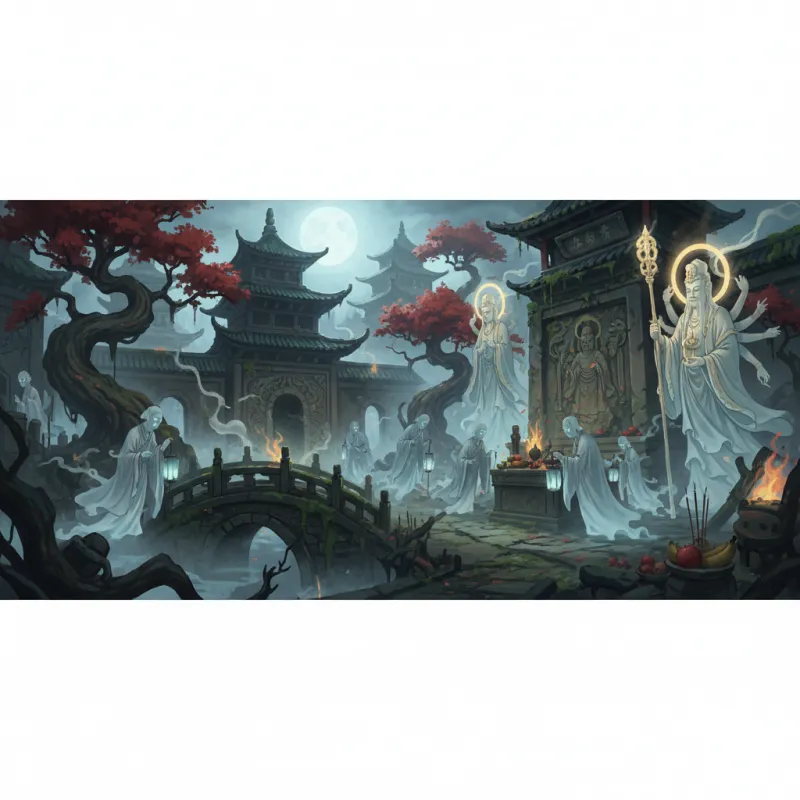
The temple keeper found her at dawn, kneeling before the altar with her hands still clasped in prayer. She'd been dead for hours. No wounds, no signs of struggle — just a woman who'd walked into the temple sometime after midnight and never walked out. The local magistrate ruled it a heart failure. The monks knew better. She was the third one that year.
There's a paradox at the heart of Chinese temple culture that nobody talks about in the tourist brochures. Temples are fortresses of divine power, protected by gods, guarded by celestial warriors like Weituo (韦陀, Wéituó) and the Four Heavenly Kings, saturated with incense smoke and the accumulated merit of ten thousand prayers. They should be the safest places in the spiritual landscape, sanctuaries where evil cannot enter and darkness cannot take root. And yet some of the most persistent, most terrifying ghost stories in Chinese folklore are set in temples. Not near temples. Not around temples. Inside them, in the halls where the gods sit watching.
The explanation is simpler — and stranger — than you'd think.
Why Divine Ground Attracts the Dead
Temples attract spirits the way hospitals attract sick people. Not because they cause the problem, but because they're where you go when you have one.
Think about it from a ghost's perspective. You've died unjustly — murdered, betrayed, abandoned. You're trapped between worlds, unable to move on, burning with grievances that won't let you rest. Where do you go? You go to the one place where the gods might actually hear you. You go to a temple.
This is why the most haunted temples in Chinese folklore aren't abandoned ruins or forgotten shrines. They're active temples, places of worship where incense burns daily and monks chant sutras. The spiritual activity doesn't repel ghosts — it attracts them. The boundary between worlds grows thin where humans and gods interact regularly. Ghosts slip through those gaps like water through cracks in a dam.
Consider the famous case of the Chenghuang Temple (城隍庙, Chénghuángmiào) in Hangzhou during the Ming Dynasty. The City God temple should have been impregnable — Chenghuang himself serves as the divine magistrate of the dead, judging souls and maintaining order in the afterlife. Yet the temple's records from the 1570s document dozens of ghost sightings, including a woman in white who appeared every night at the third watch, weeping before the main altar. The monks tried everything: exorcism rituals, protective talismans, even inviting a famous Daoist priest to cleanse the grounds. Nothing worked. The ghost kept returning.
Finally, an old monk suggested they actually listen to what she was saying. Turns out she was reciting her case — a detailed accusation of murder against her husband, repeated word for word every night. When the monks reported this to the local magistrate and an investigation was launched, the husband confessed. The woman's ghost never appeared again. She hadn't been haunting the temple. She'd been petitioning it, using the only court that would hear a dead woman's testimony.
The Geography of Temple Hauntings
Not all parts of a temple are equally haunted. Ghosts, like living petitioners, follow protocol.
The main hall (大殿, dàdiàn) where the primary deity sits is usually safe. This is the throne room, the seat of divine power. Ghosts might appear here to make their petitions, but they rarely linger. The spiritual pressure is too intense, like standing too close to a bonfire. Most spirits can't maintain their form in the direct presence of a major deity.
The real activity happens in the liminal spaces: courtyards, side halls, corridors between buildings. These are the waiting rooms of the spirit world. Ghosts gather here, sometimes for years, hoping for an audience with the gods. Some temples have specific halls dedicated to hearing petitions from the dead — the Hall of Compassion (慈悲殿, Cíbēidiàn) or the Hall of Responding to Prayers (应祷殿, Yìngdǎodiàn). These places hum with ghostly presence even in daylight.
The most dangerous spot in any temple? The bell tower and drum tower. Sound carries between worlds. When the great bell rings at dawn or the drum sounds at dusk, it resonates in both the living world and the realm of the dead. Ghosts are drawn to these sounds like moths to flame. Temple keepers know not to linger in the towers after dark. The stories of what happens to people who fall asleep in a bell tower could fill a book — and in the case of Yuewei Caotang Biji (阅微草堂笔记, Notes from the Yuewei Hermitage) by Ji Yun, they literally did.
When Gods and Ghosts Negotiate
Here's what makes temple hauntings different from other ghost stories: the gods are present. They're not absent landlords or distant cosmic forces. They're right there, sitting on their altars, watching everything unfold.
So why don't they simply banish the ghosts?
Because Chinese deities operate more like bureaucrats than warriors. They have jurisdictions, procedures, hierarchies. A ghost with a legitimate grievance has the right to petition, just like a living person has the right to file a lawsuit. The gods can't simply dismiss a case because it's inconvenient or frightening to the living. They have to hear it, investigate it, render judgment.
This creates a strange coexistence. Monks perform their daily rituals while ghosts wait in the shadows for their turn. Worshippers burn incense and pray for blessings while spirits press their own petitions. Sometimes the two groups even help each other. A ghost might warn a monk about a coming disaster. A monk might offer prayers to help a ghost resolve their grievances. The relationship is transactional, practical, almost businesslike.
The Liaozhai Zhiyi (聊斋志异, Strange Tales from a Chinese Studio) includes a story about a scholar who spent a night in a temple and encountered a female ghost. Instead of fleeing or attempting an exorcism, he asked her what she needed. She explained that her body had been improperly buried, leaving her unable to rest. The scholar reported this to the local authorities, who located and reburied her remains according to proper ritual. The ghost appeared one final time to thank him, then vanished. The temple monks later told him this ghost had been appearing for three years, but he was the first person who'd bothered to ask what she wanted.
The Dangerous Ones
Not all temple ghosts are petitioners seeking justice. Some are predators.
Temples accumulate spiritual energy the way batteries store electricity. Centuries of prayers, offerings, and rituals create a reservoir of power. Certain ghosts — the old ones, the strong ones, the ones who've learned to feed on fear and devotion — are attracted to this power. They don't come to petition the gods. They come to steal.
These are the ghosts that monks warn about, the ones that appear in the darkest hours before dawn when even the gods seem to sleep. They wear the faces of beautiful women or respected elders. They speak in soothing voices, offering help, promising answers. And if you follow them into the back corridors of the temple, into the forgotten storage rooms or the abandoned meditation cells, you might not come back.
The Taiping Guangji (太平广记, Extensive Records of the Taiping Era) compiled during the Song Dynasty includes dozens of accounts of travelers who accepted invitations from mysterious strangers in temples, only to be found days later, drained of life force, their bodies cold but unmarked. These weren't random attacks. The ghosts had been hunting, using the temple as a feeding ground, exploiting the trust that people naturally feel in sacred spaces.
This is why experienced monks never sleep alone in temples, why they perform protective rituals before sunset, why certain halls are locked after dark. They're not protecting the temple from outside threats. They're protecting visitors from what's already inside.
Living With the Dead
Modern temples handle their ghost problems with a mix of ancient ritual and practical accommodation. Some temples have specific nights when they perform rites for wandering spirits, essentially holding office hours for the dead. During these ceremonies, ghosts are invited to present their grievances, receive prayers, and hopefully move on.
Other temples take a harder line. They employ specialist monks trained in exorcism and spirit negotiation — not the dramatic, violent exorcisms you see in movies, but patient, bureaucratic processes of investigation and resolution. These monks are part detective, part lawyer, part social worker. They interview ghosts, verify their claims, and work with local authorities to resolve cases that span the boundary between life and death.
The most interesting approach comes from temples that have simply accepted their ghostly residents as part of the community. There's a famous Buddhist temple in Suzhou where the monks leave offerings in a specific courtyard every evening — not for the gods, but for the ghosts. They've been doing this for over two hundred years. The ghosts, in turn, are said to protect the temple from thieves and warn the monks of coming disasters. It's a practical arrangement, a treaty between the living and the dead.
This might seem strange to Western sensibilities, where ghosts are always threats to be eliminated. But Chinese temple culture has always been more pragmatic. The dead are still people, just people with different problems. Some of them are dangerous, yes. But most are just lost, confused, seeking help in the only place that might provide it.
The Question Nobody Asks
Here's what keeps me up at night: if temples are where ghosts go to petition the gods, what happens to the ghosts whose petitions are denied?
The stories always focus on the successful cases — the ghost who gets justice, the spirit who finds peace, the wronged soul who finally moves on. But for every ghost story with a happy ending, there must be dozens where the gods say no. Maybe the grievance isn't legitimate. Maybe the evidence is insufficient. Maybe the cosmic bureaucracy simply takes too long, and the ghost's spiritual energy dissipates before their case is heard.
What happens to those ghosts? Do they fade away, their grievances unresolved? Do they become the angry, dangerous spirits that haunt the dark corners of temples? Or do they simply wait, year after year, century after century, hoping that eventually someone will listen?
The monks I've talked to don't like this question. They change the subject, or they offer platitudes about karma and cosmic justice. But sometimes, late at night when the incense smoke hangs thick in the air and the temple is quiet except for the distant sound of chanting, I think they wonder too.
Because if temples are courts where the dead seek justice, then like all courts, they must have their failures. And those failures don't just disappear. They linger in the shadows, in the spaces between prayers, in the silence after the bell stops ringing.
They wait.
And sometimes, when conditions are right and the boundary between worlds grows thin enough, they reach out to the living, still hoping that someone, anyone, will finally hear their case.
That's the real horror of haunted temples. Not that ghosts are present, but that they might be there forever, trapped in an eternal waiting room, their petitions filed but never heard, their grievances documented but never resolved. The gods sit on their altars, the incense burns, the prayers continue. And in the dark corners, the ghosts wait for a justice that may never come.
The next time you visit a temple and feel a sudden chill, or catch movement in your peripheral vision, or hear a voice that seems to come from nowhere — maybe don't dismiss it so quickly. Maybe someone is trying to tell you their story. Maybe after years or centuries of waiting, you're the first person who might actually listen.
Just be careful where you follow them. Not all stories have happy endings. And in temples where gods and ghosts coexist, the line between petitioner and predator can be thinner than you think.
Related Reading
- The Most Haunted Temples in China: Ghost Stories from Sacred Ground
- Temple Legends: The Ghost Stories That Live in China's Sacred Spaces
- Cursed Objects in Chinese Folklore: Things You Should Never Touch
- Temple Guardian Spirits: The Supernatural Protectors of Sacred Spaces
- Zhong Kui: The Demon Queller
- Unveiling the Mysteries of Chinese Supernatural Folklore: Ghosts, Spirits, and Afterlife Beliefs
- Exploring the Multifaceted World of Chinese Supernatural Folklore and Afterlife Beliefs
Explore Chinese Culture
- Explore ancient mythical creatures
- Explore Daoist exorcism traditions
- Explore Chinese folk beliefs and superstitions