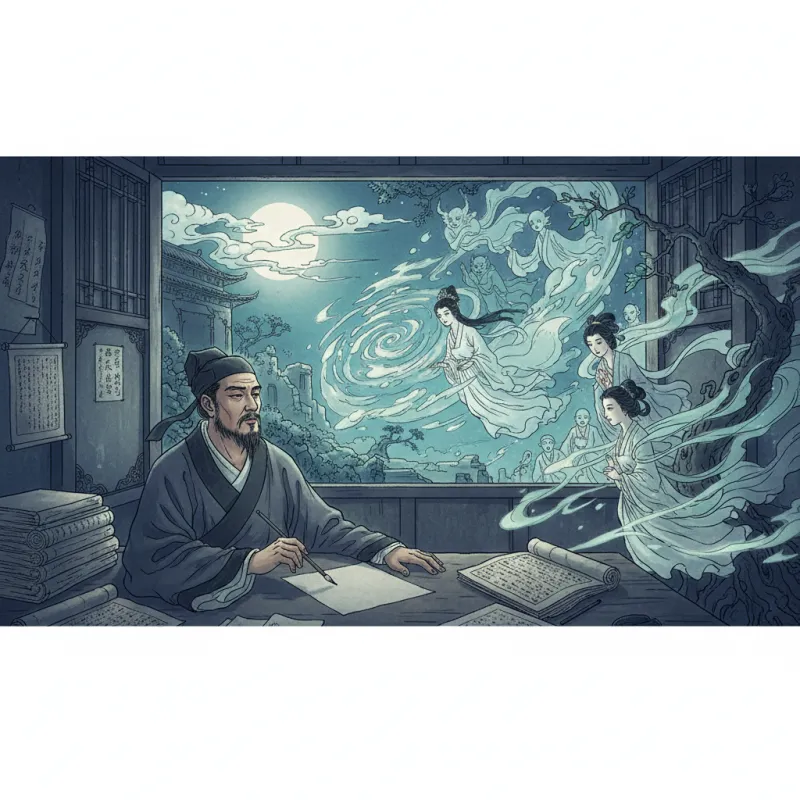
Picture this: A 71-year-old man finally passes an exam he's been taking since his twenties. His friends congratulate him. His family celebrates. And the man himself? He's too exhausted to care. The prize he's won—a minor academic degree that most scholars earn in their youth—means nothing now. His real masterpiece, the one that will make him immortal, sits in manuscript form in his study, dismissed by the literary establishment as vulgar entertainment.
This was Pu Songling (蒲松龄, Pú Sōnglíng, 1640–1715), and his story reads like one of his own tales: brilliant, bitter, and shot through with cosmic irony.
The Prodigy Who Peaked at Nineteen
Pu Songling's trajectory seemed destined for greatness from the start. In 1659, at age 19, he sat for the county-level xiucai (秀才, xiùcái) examination and didn't just pass—he dominated. He scored first in his county, first in his prefecture, and first in his circuit. The examiners praised his essays as the work of a future minister. His family, minor gentry from Zichuan in Shandong Province, must have felt their fortunes turning.
Then came the provincial examination. And he failed. He took it again. Failed. And again. And again. For the next forty years, Pu Songling would sit for the juren (举人, jǔrén) degree examination repeatedly, each time convinced this would be his breakthrough, each time walking away empty-handed. The exams tested mastery of Confucian classics and the ability to write in the rigid "eight-legged essay" format—skills Pu Songling possessed in abundance. But something about his style, his thinking, or simply his luck never aligned with what the examiners wanted.
By his forties, Pu Songling had become what Chinese society pitied most: an aged scholar (老秀才, lǎo xiùcái), a man stuck at the lowest rung of the examination ladder while younger men climbed past him into official careers.
The Tea Stall Where Ghosts Were Born
Failure forced Pu Songling into work that successful scholars would have considered beneath them. He became a private tutor for wealthy families, spending decades teaching the sons of the Bi family in Zichuan. The work was respectable but poorly paid, and it kept him away from his own family for months at a time. He supplemented his income by writing wedding announcements, funeral elegies, and legal documents for illiterate villagers.
But somewhere in these years of disappointment, Pu Songling discovered his true calling. According to legend—and with Pu Songling, legend and biography blur deliciously—he set up a tea stall by the roadside and offered free tea to travelers in exchange for stories. Ghost stories, fox spirit tales, accounts of the supernatural and strange. He'd listen, take notes, then return home to transform these oral fragments into polished literary tales.
Whether the tea stall actually existed or is itself a ghost story about the author, we'll never know. What's certain is that Pu Songling became obsessed with collecting tales of the supernatural. He gathered stories from friends, relatives, other scholars, servants, and wanderers. He read voraciously in the zhiguai (志怪, zhìguài) tradition—the "records of anomalies" that stretched back to the Han Dynasty. And he began writing.
The result was Liaozhai Zhiyi (聊斋志异, Liáozhāi Zhìyì), usually translated as "Strange Tales from a Chinese Studio." The title refers to Pu Songling's study, which he named Liaozhai—"Studio of Leisure." The irony is sharp: a man with no leisure, trapped in tutoring jobs and examination preparation, calling his workspace a place of rest. Readers interested in the collection itself should explore Liaozhai Zhiyi: The Ghost Stories That Changed Chinese Literature.
Why a Failed Scholar Wrote Better Ghost Stories
Here's what makes Pu Songling's failure crucial to understanding his genius: he wrote from the margins. Successful scholars wrote to demonstrate their mastery of orthodox Confucian thought. They wrote to impress examiners, to advance their careers, to shore up the social order. Pu Songling wrote because he had nothing left to lose.
His stories are populated by examination candidates who meet fox spirits, scholars who fall in love with ghosts, and young men whose lives are destroyed by the examination system. In "Ye Sheng," a talented scholar fails the exams repeatedly until a ghost teaches him the secret: the examiners don't want brilliance, they want conformity. In "Wang Zian," a candidate dies from the stress of examination preparation, and his ghost continues taking the test. These aren't just ghost stories—they're savage critiques of the system that broke Pu Songling.
But he also wrote with sympathy for the supernatural creatures that Confucian orthodoxy condemned. His fox spirits aren't always seductresses leading men to ruin; sometimes they're more moral than humans. His ghosts aren't always vengeful; sometimes they're just lonely. His demons can be redeemed. This moral complexity, this refusal to accept simple categories of good and evil, makes his stories feel modern even three centuries later.
The examination system demanded rigid thinking in rigid forms. Pu Songling's failure freed him to write with flexibility, imagination, and emotional truth. His stories use classical Chinese prose, yes, but they're infused with vernacular energy and psychological realism that the "eight-legged essay" could never contain.
The Manuscript That Nobody Wanted
Pu Songling worked on Liaozhai Zhiyi for decades, constantly revising, adding new stories, polishing old ones. By the 1670s, he had a substantial collection. He showed it to friends. Some praised it. Others dismissed it as frivolous, a waste of his classical education. The literary establishment, such as it was, had no interest in ghost stories written in classical Chinese. If you wanted supernatural tales, you read vernacular novels. If you wanted classical prose, you read serious essays about governance and morality.
Pu Songling's work fell into an uncomfortable middle ground: too literary for popular audiences, too popular for literary audiences. He couldn't find a publisher. The manuscript circulated in handwritten copies among friends and fellow scholars, but it remained unpublished during his lifetime.
Meanwhile, Pu Songling kept taking examinations. In 1711, at age 71, he finally passed the gongsheng (贡生, gòngshēng) examination, earning a degree that qualified him for minor official appointments. By then, he was too old and too tired to pursue an actual position. He died four years later in 1715, still a failed scholar by the standards of his society.
The Afterlife of a Ghost Story Writer
Here's where Pu Songling's story becomes one of his own tales: the failed scholar achieved immortality, just not in the way he expected. Liaozhai Zhiyi was first published in 1766, fifty-one years after his death. It became a sensation. Readers loved the stories. Scholars began to recognize their literary merit. By the 19th century, Liaozhai Zhiyi was acknowledged as a masterpiece of classical Chinese prose.
Today, Pu Songling is far more famous than any of the examiners who failed him. His stories have been translated into dozens of languages, adapted into films, television series, operas, and comic books. The examination system he struggled against was abolished in 1905. The essays he wrote to impress examiners are forgotten. But his ghost stories endure.
There's a particular story in Liaozhai called "The Painted Skin" about a demon who wears a beautiful human disguise. It's been interpreted as a metaphor for the examination system itself—a beautiful exterior hiding a monstrous reality. Whether Pu Songling intended this reading or not, it captures something essential about his life: he saw through the painted skin of his society's values and wrote about what lay beneath.
What Pu Songling Teaches Us About Failure
Pu Songling's biography raises uncomfortable questions about success and failure. By every measure his society valued, he was a failure. He never held office. He never achieved wealth or status. He spent his life in obscurity, teaching other people's children and writing stories that nobody would publish.
But he also created something that outlasted the entire system that rejected him. His "failure" freed him to write with honesty and imagination. His marginalization gave him perspective on the cruelty and absurdity of social hierarchies. His disappointment fueled some of the most psychologically acute fiction in Chinese literature.
Would a successful Pu Songling have written Liaozhai Zhiyi? Almost certainly not. Success would have channeled his talents into official documents, policy essays, and the kind of respectable literature that nobody reads anymore. Failure made him an artist.
This doesn't romanticize failure—Pu Songling's life was hard, and he suffered real poverty and humiliation. But it does suggest that our society's definitions of success and failure are often backwards. The examination system was designed to identify talent and reward merit. It failed spectacularly in Pu Songling's case, rejecting one of the greatest writers of the Qing Dynasty while promoting countless mediocrities to high office.
The Studio of Leisure, Three Centuries Later
Pu Songling's study in Zichuan still exists, preserved as a museum. Visitors can see his desk, his books, and the space where he wrote his ghost stories. It's a small, modest room—nothing like the grand estates of successful officials. But it's become a pilgrimage site for writers and readers who understand that literary immortality matters more than bureaucratic success.
The name "Liaozhai"—Studio of Leisure—remains ironic. Pu Songling had no leisure. He worked constantly, teaching, writing, preparing for examinations he'd never pass. But perhaps the name reflects a deeper truth: in his writing, he found a kind of freedom that success could never have given him. In his studio, surrounded by ghosts and fox spirits and failed scholars, he was finally at leisure from the demands of a society that had no place for him.
For readers interested in exploring the supernatural world that Pu Songling documented, Chinese Fox Spirits: Seduction, Transformation, and Moral Ambiguity offers insight into one of his favorite subjects. His work also influenced later traditions of Chinese Ghost Stories and the Art of the Supernatural Tale.
The failed scholar who wrote China's greatest ghost stories teaches us this: sometimes the system is wrong. Sometimes failure is a door to something better. And sometimes the ghosts we create outlive the empires that rejected us.
Related Reading
- The Liaozhai Stories That Hollywood Should Adapt (But Probably Won't)
- What is Liaozhai Zhiyi? A Guide to China's Greatest Ghost Stories
- Painted Skin: The Most Terrifying Story in Chinese Literature
- Nie Xiaoqian: The Ghost Romance That Conquered Cinema
- The Afterlife in Chinese Culture: A Traveler's Guide to the Underworld
- Unveiling the Secrets of Chinese Supernatural Folklore and Afterlife Beliefs
- Dream Spirits and Sleep Demons: The Supernatural World of Chinese Dreams
Explore Chinese Culture
- Explore ancient mythical creatures
- Explore Daoist exorcism traditions
- Explore Chinese folk beliefs and superstitions