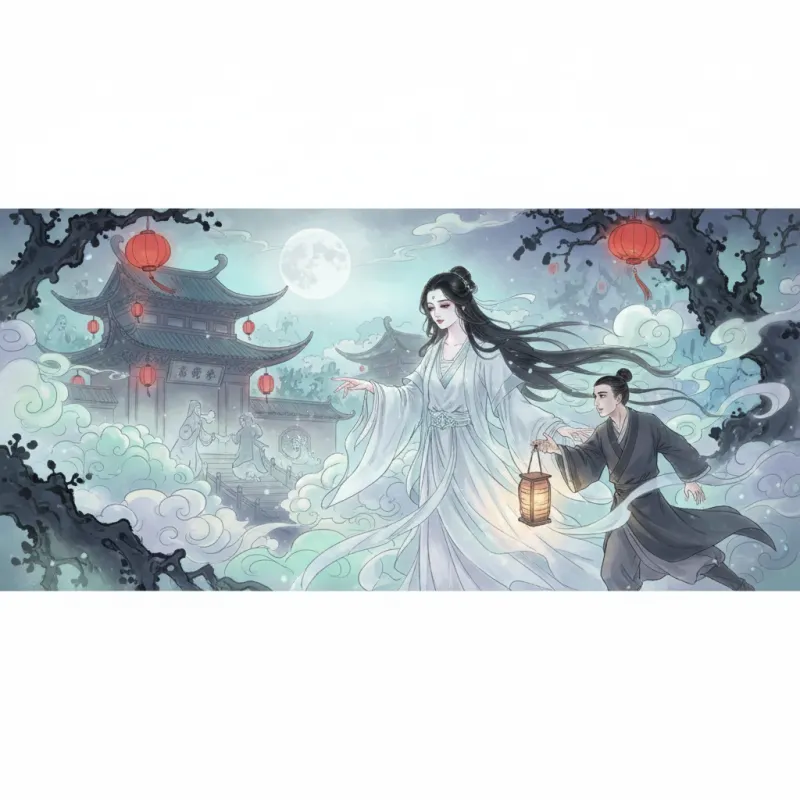
A young scholar walks into an abandoned temple at dusk, ignoring the warnings of locals who cross themselves and hurry past. He spreads his bedroll in a dusty corner, lights a candle, and opens his books. Within the hour, he'll meet a woman so beautiful she seems unreal—because she isn't. She's dead, enslaved by a demon, and commanded to seduce him so the demon can feast on his organs. But something unexpected happens: she falls in love with him instead. This is the story of Nie Xiaoqian (聂小倩, Niè Xiǎoqiàn), and it's been breaking hearts and box office records for over three centuries.
Why This Ghost Story Won't Die
Pu Songling wrote nearly 500 tales for his collection Strange Tales from a Chinese Studio (聊斋志异, Liáozhāi Zhìyì), but Nie Xiaoqian's story has been adapted more than any other—over 20 film versions, countless TV series, operas, anime, and video games. The 1987 Hong Kong film A Chinese Ghost Story alone spawned two sequels, a TV series, an animated version, and a 2011 remake. What makes this particular ghost so irresistible?
The answer lies in what Nie Xiaoqian represents: a woman trapped by circumstances beyond her control, forced to commit evil acts she despises, who finds redemption through genuine love. She's not a monster pretending to be human—she's a human forced to act like a monster. That distinction matters. In a culture where filial piety and duty often override personal desire, Nie Xiaoqian's rebellion against her demonic master resonates as both romantic and revolutionary.
The Scholar Who Wouldn't Run
Ning Caichen (宁采臣, Níng Cǎichén) isn't your typical hero. He's not a warrior, not a Taoist exorcist, not even particularly clever. He's a poor scholar traveling to take the imperial examinations, and when he arrives at Jinhua (金华) and needs a place to sleep, he chooses an abandoned temple because it's free. The locals warn him—of course they do, this is a Liáozhāi story—but Ning is either brave or broke enough to ignore them.
What makes Ning compelling is his decency. When Xiaoqian appears and tries to seduce him, he's attracted but cautious. When she confesses she's a ghost enslaved by a demon, he doesn't flee in terror. When she warns him to leave before the demon kills him, he worries about what will happen to her. This is radical behavior in Chinese ghost literature, where the standard response to discovering your lover is dead is to run screaming or die of fright. Ning treats Xiaoqian like a person in trouble, not a supernatural threat.
The original story, written during the Qing Dynasty (1644-1912), reflects Pu Songling's consistent theme: the supernatural world is often more honest and honorable than the human one. Ning encounters corrupt officials and greedy merchants throughout his travels, but the ghost shows him genuine compassion. It's a pointed critique wrapped in a love story.
The Demon in the Details
The antagonist is a tree demon called Lao Lao (姥姥, Lǎolao, literally "grandmother"), though some translations call her the Black Mountain Demon. She's enslaved multiple female ghosts, forcing them to lure men to the temple so she can drain their life essence. Xiaoqian has been doing this for years, and she's good at it—until she meets someone who treats her like a human being instead of a seduction target.
The demon represents systemic oppression in a way that feels remarkably modern. Xiaoqian can't simply refuse her orders; the demon will torture her or destroy her spirit entirely. She's caught in an exploitative system where her beauty is weaponized against her will. When she finally rebels, it's not because she's suddenly brave—it's because Ning offers her something worth risking destruction for: the possibility of being seen as herself.
This dynamic appears throughout Liáozhāi, where fox spirits and female ghosts often have more integrity than living humans. Pu Songling seemed to believe that society's treatment of women—particularly the practice of forced marriages and concubinage—created a kind of living death worse than actual ghosthood.
From Page to Screen: The 1987 Revolution
The 1987 film A Chinese Ghost Story (倩女幽魂, Qiànnǚ Yōuhún), directed by Ching Siu-tung and produced by Tsui Hark, transformed Nie Xiaoqian from a literary character into a cultural icon. Leslie Cheung played Ning Caichen as an endearingly bumbling scholar, while Joey Wong's Xiaoqian became the template for every tragic ghost heroine that followed. The film added a Taoist swordsman named Yan Chixia (燕赤霞, Yàn Chìxiá)—a character who appears in other Liáozhāi stories but not the original Xiaoqian tale—to provide comic relief and demon-fighting expertise.
What the film understood brilliantly was the story's core tension: Xiaoqian and Ning can't be together in any conventional sense. She's dead. He's alive. Their love is literally impossible, which makes every moment they share precious and doomed. The film's most iconic scene—Xiaoqian's hair whipping in supernatural wind as she warns Ning to flee—captures this perfectly. She's trying to save him by pushing him away, and he's refusing to abandon her. It's romantic precisely because it's hopeless.
The film also leaned into the horror elements that adaptations sometimes soften. The tree demon is genuinely terrifying, with a massive tongue that impales victims and roots that burst through floors. The temple setting drips with decay and menace. This isn't a sanitized fairy tale—it's a horror romance where the stakes are life, death, and eternal damnation.
The Reincarnation Cycle: Endless Adaptations
Since 1987, Nie Xiaoqian has been reincarnated more times than a Buddhist monk. The 2011 remake cast Liu Yifei as Xiaoqian and Louis Koo as Ning, with higher production values but less emotional impact. A 2020 animated film reimagined the story with Xiaoqian as a more active protagonist. TV series have stretched the tale across 40+ episodes, adding subplots about demon politics and past-life connections.
Each adaptation reflects its era's anxieties. The 1987 version, made as Hong Kong faced its 1997 handover to China, emphasized themes of displacement and impossible love across boundaries. The 2011 version, produced during China's economic boom, featured spectacular CGI battles and a more action-oriented Ning. Recent adaptations have given Xiaoqian more agency, letting her fight alongside Ning rather than simply being rescued.
The story has also migrated into video games, where players can romance Xiaoqian in games like Onmyoji and Tale of Wuxia. In these versions, she's often a playable character with combat abilities, a far cry from the helpless ghost of the original tale. This evolution reflects changing attitudes toward female characters—modern audiences want Xiaoqian to save herself, not just inspire Ning to save her.
What Xiaoqian Teaches Us About Chinese Ghost Stories
Nie Xiaoqian's enduring appeal reveals something essential about Chinese supernatural fiction: ghosts aren't just scary, they're tragic. Unlike Western horror, where ghosts are often malevolent spirits seeking revenge, Chinese ghost stories frequently feature spirits who are victims themselves—of murder, injustice, or cruel fate. They haunt the living not from malice but from unfinished business or unresolved longing.
Xiaoqian embodies this perfectly. She's not evil; she's enslaved. She doesn't want to kill Ning; she's forced to try. When she's finally freed—in most versions, through Ning's help and a Taoist exorcist's intervention—she can either be reincarnated or remain as a benevolent spirit. The story suggests that even death isn't permanent if love is strong enough, a theme that resonates deeply in a culture that maintains ancestral altars and believes the dead remain connected to the living.
This is why Xiaoqian's story keeps getting retold. It's not just a ghost story or a romance—it's a meditation on agency, exploitation, and the possibility of redemption. In a world where people often feel trapped by circumstances beyond their control, Xiaoqian's rebellion against her demon master offers hope. And in a culture that values duty and propriety, Ning's decision to help a ghost at great personal risk celebrates the kind of moral courage that transcends social convention.
The Ghost Who Lives Forever
Three centuries after Pu Songling wrote her story, Nie Xiaoqian remains more alive than most living characters in Chinese popular culture. She's been a film star, an anime heroine, a video game character, and an opera diva. She's been played by dozens of actresses, reimagined by countless writers, and loved by millions of readers and viewers.
The secret to her immortality isn't complicated: she's a character who feels real despite being supernatural, who makes difficult choices despite having limited options, and who loves deeply despite knowing it's doomed. She's trapped between worlds—dead but not gone, enslaved but not broken, ghostly but achingly human. That's a combination that transcends any single adaptation or era.
So the next time you see another Nie Xiaoqian adaptation announced, don't roll your eyes at yet another remake. Instead, recognize it for what it is: proof that some stories are too powerful to stay buried, and some ghosts are too beloved to ever truly die. Xiaoqian has conquered cinema, television, literature, and gaming not through supernatural power, but through something more potent: a story that speaks to the human heart across centuries and cultures. For a ghost, that's the best kind of immortality.
Related Reading
- The Liaozhai Stories That Hollywood Should Adapt (But Probably Won't)
- Pu Songling: The Failed Scholar Who Wrote China's Greatest Ghost Stories
- What is Liaozhai Zhiyi? A Guide to China's Greatest Ghost Stories
- Painted Skin: The Most Terrifying Story in Chinese Literature
- Liaozhai Zhiyi: The Ghost Stories That Changed Chinese Literature
- Cursed Objects in Chinese Folklore: Things You Should Never Touch
- The Hungry Ghost Festival: When the Gates of Hell Open
- Chinese Horror Literature: From Liaozhai to Modern Thrillers
Explore Chinese Culture
- Explore ancient mythical creatures
- Explore Daoist exorcism traditions
- Explore Chinese folk beliefs and superstitions