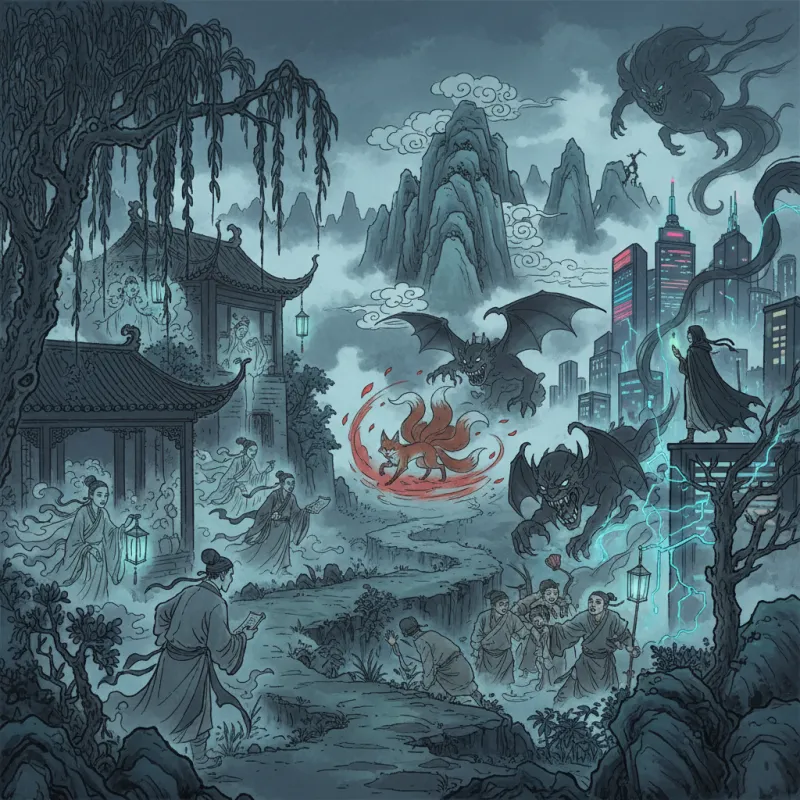
The scholar Pu Songling spent forty years collecting ghost stories. Not writing them — collecting them. He'd set up a tea stall by the roadside and offer free drinks to travelers who'd share their supernatural encounters. By the time he finished Strange Tales from a Chinese Studio (聊斋志异, Liáozhāi Zhìyì) in 1679, he'd compiled 491 tales of fox spirits, vengeful ghosts, and bureaucratic demons. He died believing he'd documented reality. His readers knew better — but they also knew he'd created something that would haunt Chinese literature for the next three centuries.
This is the paradox at the heart of Chinese horror literature: it pretends to be true. Even when a story features a woman who transforms into a fox at midnight or a scholar who discovers his wife has been dead for ten years, the narrative voice remains calm, factual, almost bureaucratic. The horror doesn't come from the supernatural event itself. It comes from the matter-of-fact way it's reported, as if ghosts filing paperwork in the underworld is the most natural thing in the world.
The Zhiguai Tradition: When History Met Horror
Long before Pu Songling set up his tea stall, Chinese writers were blurring the line between history and horror. The zhiguai (志怪) tradition — literally "records of anomalies" — emerged during the Wei and Jin dynasties (220-420 CE), when China was fragmenting into warring kingdoms and Daoist philosophy was challenging Confucian orthodoxy. Scholars like Gan Bao compiled collections like In Search of the Supernatural (搜神记, Sōushénjì), presenting ghost encounters and spirit possessions as historical facts worthy of preservation.
These weren't campfire tales meant to thrill. They were serious attempts to document a world where the supernatural was simply another category of natural phenomena. A typical zhiguai entry reads like a police report: "In the third year of the Taikang era, in Donghai commandery, a man named Zhou Qing encountered a woman in white by the river. She claimed to be the daughter of the local magistrate, dead for three years. She requested that Zhou inform her family of her whereabouts in the afterlife." No dramatic buildup. No atmospheric description. Just the facts, presented with the same tone you'd use to record a property transaction.
This documentary style became the DNA of Chinese horror. Even modern Chinese horror novels maintain this quality — the sense that the author is reporting something that happened rather than inventing something to scare you. It's why Chinese ghost stories feel fundamentally different from Western horror: they're not trying to convince you that ghosts exist. They're assuming you already know they do.
Pu Songling's Revolution: Making Ghosts Human
Strange Tales from a Chinese Studio changed everything by doing something radical: it made readers care about the ghosts. Previous zhiguai collections treated supernatural beings as curiosities to be catalogued. Pu Songling treated them as people — often more sympathetic than the living humans they encountered.
Take "Nie Xiaoqian" (聂小倩), one of his most famous tales. Xiaoqian is a ghost forced by a demon to seduce and kill young scholars. When she meets Ning Caichen, she falls in love with him instead and warns him to flee. The horror isn't that she's a ghost — it's that she's trapped in an exploitative relationship with a demon who treats her as property. The story works as supernatural horror, but it also works as social commentary about women's lack of agency in Qing dynasty China. The ghost is the victim. The real monster is the system.
This pattern repeats throughout Liáozhāi. Fox spirits are more loyal than human wives. Ghosts are more honest than living officials. The supernatural realm operates with more justice than the human world. Pu Songling was using horror to critique his society — and he was doing it so subtly that the Qing censors never caught on. They thought he was just writing entertaining ghost stories.
The influence is impossible to overstate. Every major Chinese horror writer since Pu Songling has been in conversation with Liáozhāi. The sympathetic ghost. The corrupt official. The scholar who falls in love with something he shouldn't. These became the building blocks of Chinese horror, repeated and remixed for three centuries.
The Republican Era: Horror Meets Modernity
When the Qing dynasty collapsed in 1911, Chinese horror literature faced an identity crisis. The old supernatural framework — with its Daoist priests, Buddhist monks, and Confucian scholars — suddenly seemed outdated. How do you write ghost stories in a country trying to modernize, to catch up with the West, to embrace science and rationality?
Writers like Lu Xun (鲁迅) found a solution: make the horror psychological. His 1918 story "Diary of a Madman" (狂人日记, Kuángrén Rìjì) features a protagonist who becomes convinced that everyone around him is a cannibal. Is he insane, or is he the only one seeing the truth about Chinese society? Lu Xun never answers the question. The ambiguity is the point. The horror isn't supernatural — it's the realization that traditional Chinese culture might be devouring its own children.
This shift from supernatural to psychological horror dominated Republican-era literature. Writers used horror tropes to explore China's traumatic modernization: the collapse of traditional family structures, the violence of warlord conflicts, the invasion by foreign powers. The ghosts became metaphors. But they never entirely disappeared. Chinese readers weren't ready to give up their fox spirits and hungry ghosts. They just wanted them updated for the twentieth century.
The Communist Interlude: When Horror Went Underground
After the Communist Party took power in 1949, supernatural horror literature effectively ceased to exist in mainland China. The new government promoted "socialist realism" — literature that depicted the triumph of the working class and the building of a new society. Ghost stories were dismissed as "feudal superstition," incompatible with Marxist materialism. For three decades, Chinese horror went underground.
But it didn't die. It migrated. Hong Kong and Taiwan became the new centers of Chinese horror literature, free from mainland censorship. Writers like Ni Kuang (倪匡) created the Wisely series, blending horror with science fiction and detective fiction. The stories featured ancient curses, alien encounters, and government conspiracies — everything the mainland censors would have banned. Meanwhile, Hong Kong cinema was developing its own horror aesthetic, drawing on Liáozhāi tales but adding martial arts, comedy, and increasingly graphic violence.
The mainland's loss was the diaspora's gain. By the time China began opening up in the 1980s, Chinese horror had evolved in directions that would have been impossible under Communist rule. The genre had become more diverse, more experimental, more willing to blend Chinese and Western influences. Chinese exorcism traditions found new life in Hong Kong horror films, while Taiwanese writers were creating psychological horror that rivaled anything coming out of Japan or Korea.
The Contemporary Boom: Horror in the Digital Age
The real explosion came in the 2000s, with the rise of Chinese internet literature. Suddenly, writers could publish horror stories online without going through state censors or traditional publishers. Platforms like Qidian and Jinjiang became home to thousands of horror serials, some running to millions of words. The genre diversified wildly: urban legends set in modern Chinese cities, historical horror set during the Cultural Revolution, cosmic horror influenced by H.P. Lovecraft, survival horror inspired by Japanese and Korean trends.
Cai Jun (蔡骏) became the first Chinese horror writer to achieve mainstream commercial success with novels like The 19th Floor of Hell (地狱的第19层, Dìyù de Dì-19 Céng). His work blends traditional Chinese supernatural elements with modern thriller pacing and psychological complexity. A typical Cai Jun novel might feature a protagonist investigating a series of mysterious deaths, only to discover connections to ancient curses, government cover-ups, and their own repressed memories. It's Liáozhāi meets The Ring meets Gone Girl.
Zhou Dedong (周德东) took a different approach, creating what he calls "psychological horror" — stories where the supernatural might be entirely in the protagonist's mind. His novel The Door (门, Mén) follows a man who becomes obsessed with a mysterious door in his apartment building. Is there really something supernatural behind it, or is he having a breakdown? Zhou never fully answers the question, maintaining the ambiguity that Lu Xun pioneered a century earlier.
The most interesting development is how contemporary Chinese horror writers are reclaiming and reinterpreting traditional supernatural elements. Fox spirits appear in urban fantasy novels, navigating modern Shanghai instead of ancient forests. Hungry ghosts haunt apartment complexes instead of graveyards. The Chinese underworld bureaucracy gets updated with computers and surveillance cameras. The old supernatural framework hasn't been abandoned — it's been upgraded for the twenty-first century.
The International Breakthrough: Chinese Horror Goes Global
For decades, Chinese horror literature remained largely unknown outside the Chinese-speaking world. That's changing. Translations are increasing. Chinese horror films are finding international audiences. Writers like A Yi (阿乙) and Yan Ge (颜歌) are being published in English, introducing Western readers to contemporary Chinese horror that's both familiar and utterly alien.
The appeal is partly the novelty — Western readers raised on Stephen King and Shirley Jackson are discovering a horror tradition with completely different rules and assumptions. But it's also the quality. The best Chinese horror writers are doing things that Western horror rarely attempts: blending supernatural terror with social commentary, maintaining ambiguity about whether the horror is real or psychological, treating ghosts as fully realized characters rather than mere threats.
There's also a growing recognition that Chinese horror has always been more sophisticated than it's been given credit for. Pu Songling wasn't just writing entertaining ghost stories — he was creating complex narratives about power, gender, and social justice. Lu Xun wasn't just using horror as metaphor — he was exploring the psychological trauma of living through China's violent modernization. Contemporary writers aren't just imitating Western horror — they're synthesizing three thousand years of Chinese supernatural literature with modern narrative techniques.
The Future: Where Chinese Horror Is Heading
The next generation of Chinese horror writers is more globally connected than any previous generation. They've read Stephen King and Shirley Jackson alongside Pu Songling and Lu Xun. They've watched Japanese horror films and Korean thrillers alongside Hong Kong ghost movies. They're creating a hybrid horror aesthetic that draws on multiple traditions while remaining distinctly Chinese.
The themes are evolving too. Contemporary Chinese horror is increasingly concerned with technology — surveillance states, social credit systems, artificial intelligence, virtual reality. But these modern anxieties are being filtered through traditional Chinese supernatural frameworks. What happens when a fox spirit tries to navigate facial recognition software? How does the underworld bureaucracy handle digital records? Can a ghost haunt a smart home?
The documentary quality that defined the earliest zhiguai collections is finding new expression in found footage narratives, social media horror, and stories structured as investigative journalism. The line between fact and fiction is blurring again — but now it's blurring in WeChat threads and Weibo posts instead of scholarly compilations.
Chinese horror literature has always been about more than scaring readers. It's been a way to talk about things that couldn't be discussed directly: political corruption, social injustice, the trauma of historical violence, the anxiety of rapid change. That function hasn't changed. What's changed is the sophistication of the tools available to writers, and the size of the potential audience.
Pu Songling spent forty years collecting ghost stories by the roadside. Today's Chinese horror writers are collecting them from millions of internet users, remixing them in real-time, and publishing them to a global audience. The ghosts are still here. They've just learned to use smartphones.
Related Reading
- The Best Chinese Horror Films: A Genre Guide — Cnspirit Perspective
- Chinese Horror Novels and Web Fiction: A Reading Guide
- Chinese Internet Ghost Stories: The Creepypasta of the East — Cnspirit Perspective
- Jiangshi: The Hopping Vampire Genre That Conquered Hong Kong Cinema
- The Legend of the White Snake: A Complete Retelling
- Chinese Urban Legends: The Ghost Stories Your Taxi Driver Tells
- Exploring the Depths of Chinese Supernatural Folklore: Ghosts, Spirits, and Afterlife Beliefs
Explore Chinese Culture
- Explore ancient mythical creatures
- Explore Daoist exorcism traditions
- Explore Chinese folk beliefs and superstitions