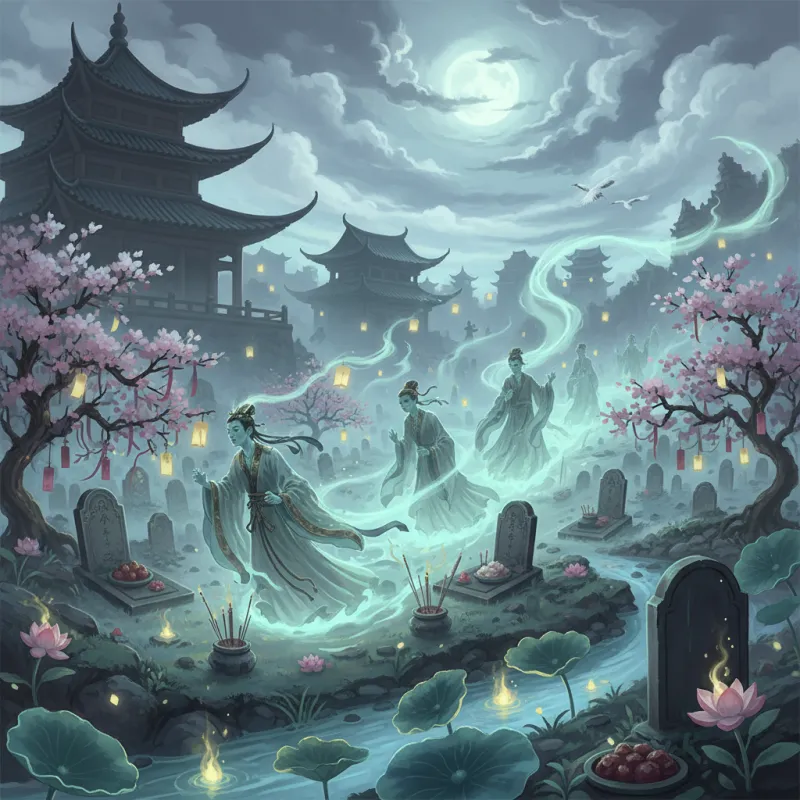
Every year on the fourth or fifth of April, China's highways transform into rivers of the living flowing toward the dead. Four hundred million people abandon their offices, lock their apartments, and journey—sometimes hundreds of miles—to sweep a grave. They bring offerings of fruit, burn paper money that spirals into ash, and pull weeds from headstones with the same dutiful attention they'd give to cleaning their own homes. This is 清明节 (Qīngmíng Jié), the Qingming Festival, and it represents something the modern world has largely forgotten: that the dead have needs, and the living have obligations.
The Festival That Refused to Die
Qingming's survival is remarkable. The festival traces its roots to the Zhou Dynasty (1046–256 BCE), making it over two millennia old, but its formal establishment as a holiday came during the Tang Dynasty (618–907 CE). What's extraordinary isn't just its age—it's that Qingming endured the Cultural Revolution, a period when traditional customs were systematically dismantled. While temples burned and ancestral tablets were smashed, families continued visiting graves in secret, risking political persecution to maintain the connection between worlds.
In 2008, the Chinese government reinstated Qingming as an official public holiday, acknowledging what had always been true: you can't legislate away the dead. The festival had survived underground, practiced in whispers and early morning visits when authorities weren't watching. Its resurrection as a national holiday wasn't a revival—it was an admission that it had never truly disappeared.
What the Dead Require
The Chinese term 扫墓 (sǎomù), literally "sweeping the tomb," describes the festival's core activity, but this translation barely scratches the surface. Families don't just clean graves—they restore them. They scrub headstones, trim overgrown grass, repaint faded characters, and repair cracked stone. The grave must be presentable, because the ancestors are watching, and neglect is a form of abandonment.
But physical maintenance is only the beginning. The dead require sustenance, and Qingming is when the living provide it. Families arrange elaborate offerings: fresh fruit, cooked meals, rice wine, tea, and the deceased's favorite foods. A grandfather who loved baijiu gets a bottle placed at his headstone. A grandmother who made the best dumplings receives a plate of them, still steaming. These aren't symbolic gestures—in the Chinese cosmology, the dead can consume the spiritual essence of these offerings, even as the physical food remains untouched.
Then comes the burning. Stacks of 纸钱 (zhǐqián), "paper money," go up in flames, the smoke carrying wealth to the afterlife. But modern Qingming has expanded the catalog of paper offerings to absurd and touching extremes. You can now buy paper versions of smartphones, luxury cars, designer handbags, even miniature paper mansions complete with furniture. The logic is consistent: if the dead need money, they also need the things money buys. Some families burn paper credit cards, hedging their bets on the afterlife's financial infrastructure.
The Cold Food Connection
Qingming absorbed an older festival called 寒食节 (Hánshí Jié), the "Cold Food Festival," which fell one or two days before it. The Cold Food Festival commemorates Jie Zitui, a loyal retainer from the Spring and Autumn Period (770–476 BCE) who cut flesh from his own thigh to feed his starving lord during exile. When the lord later became Duke Wen of Jin, Jie refused rewards and retreated to the mountains with his mother. The duke, hoping to force Jie out, set the mountain on fire. Jie and his mother died in the flames, clutching a tree.
The duke, devastated, ordered that no fires be lit on the anniversary of Jie's death—hence "Cold Food," when families ate only cold meals. Over centuries, this festival merged with Qingming, and while few people still observe the no-fire rule, the story of Jie Zitui lingers as a reminder that loyalty to the dead can demand everything from the living.
Ghosts, Graves, and the Hungry Dead
Qingming exists within a larger framework of Chinese death customs that acknowledge the dead as active participants in the world. Unlike the Western notion of heaven as a distant, separate realm, Chinese cosmology places the afterlife in closer proximity. The dead dwell in 阴间 (yīnjiān), the "yin realm," which runs parallel to our world and occasionally intersects with it. Qingming is one of those intersection points—a day when the boundary thins and communication becomes possible.
This proximity creates obligations. Neglected ancestors can become 饿鬼 (èguǐ), "hungry ghosts," desperate spirits who wander the earth seeking sustenance. The Hungry Ghost Festival in the seventh lunar month addresses these wandering dead more broadly, but Qingming focuses specifically on family ancestors. The message is clear: tend to your dead, or they will suffer. And suffering ancestors don't stay quiet—they send misfortune, illness, and bad luck to their negligent descendants.
The Living Among the Dead
Modern Qingming has developed its own peculiar culture. Cemeteries become temporary cities, packed with families who spread blankets, share meals, and catch up on family news while sitting beside graves. Children play between headstones. Vendors sell flowers, incense, and paper offerings at inflated prices. Traffic jams stretch for miles as urban Chinese return to rural ancestral villages.
The scale is staggering. In 2019, before the pandemic, Chinese authorities estimated that 295 million people visited graves during the three-day Qingming holiday period. That's nearly the entire population of the United States, all moving toward cemeteries simultaneously. High-speed rail tickets sell out weeks in advance. Flower prices triple. Some cities have implemented online grave-sweeping services for those who can't travel, where hired workers will clean graves and livestream the process—a solution that feels both pragmatic and spiritually dubious.
The Weight of Continuity
What makes Qingming profound isn't the ritual itself—it's the unbroken chain it represents. When you sweep your grandfather's grave, you're performing the same act your grandfather performed for his grandfather, extending back through generations until the names blur into legend. This continuity creates a form of immortality: as long as someone remembers to sweep your grave, you haven't truly died.
This is why childlessness was traditionally considered a tragedy in Chinese culture—not just for the living, but for the dead. Without descendants, who would tend your grave? Who would burn offerings? Who would remember your name? The fear wasn't death itself, but the second death: being forgotten, becoming one of the nameless hungry ghosts who wander without family or sustenance.
Qingming makes this fear tangible. Every swept grave is a promise: I remember you. Every offering is a declaration: you still matter. Every weed pulled is an act of defiance against oblivion. In a world increasingly focused on the future, Qingming insists that we turn around and face the past, acknowledging that we are not self-made but rather links in a chain that extends far beyond our individual lives.
The Festival's Modern Tensions
Contemporary China struggles with Qingming's implications. Urbanization has scattered families across the country, making annual grave visits logistically complex. Cremation, now mandatory in most Chinese cities, has replaced traditional burial, creating new questions about how to honor ashes in a columbarium versus a traditional grave plot. Environmental concerns about burning paper offerings have led some cities to ban the practice, offering "eco-friendly" alternatives that feel spiritually insufficient to many practitioners.
Yet Qingming persists, adapting without abandoning its core purpose. Families video-call relatives who can't attend. Some burn paper offerings in designated areas away from graves. Others have embraced the contradiction, acknowledging that honoring the dead sometimes means bending the rules the living have created. The festival's resilience suggests something fundamental: the human need to maintain connection with the dead isn't cultural—it's existential.
When you understand Qingming, you understand something essential about Chinese approaches to death and ancestor worship. The dead aren't gone—they're relocated. They still need care, still deserve respect, still maintain their place in the family structure. And once a year, on a clear and bright spring day, the living set aside everything else to prove it.
Related Reading
- Chinese Death Customs That Surprise Westerners
- Joss Paper: Burning Money for the Dead
- Chinese Funerals: A Complete Guide to Death Customs and Rituals
- Ancestor Worship: The Living Relationship with the Dead
- Unveiling Chinese Supernatural Folklore: Ghosts, Spirits, and Afterlife Beliefs
- The Most Haunted Temples in China: Ghost Stories from Sacred Ground
- Daoist Exorcism Rituals Explained: How to Kick Out a Demon the Chinese Way
- Modern Spirit Mediums in Taiwan: Where Gods Still Talk Through People
Explore Chinese Culture
- Explore ancient mythical creatures
- Explore Daoist exorcism traditions
- Explore Chinese folk beliefs and superstitions