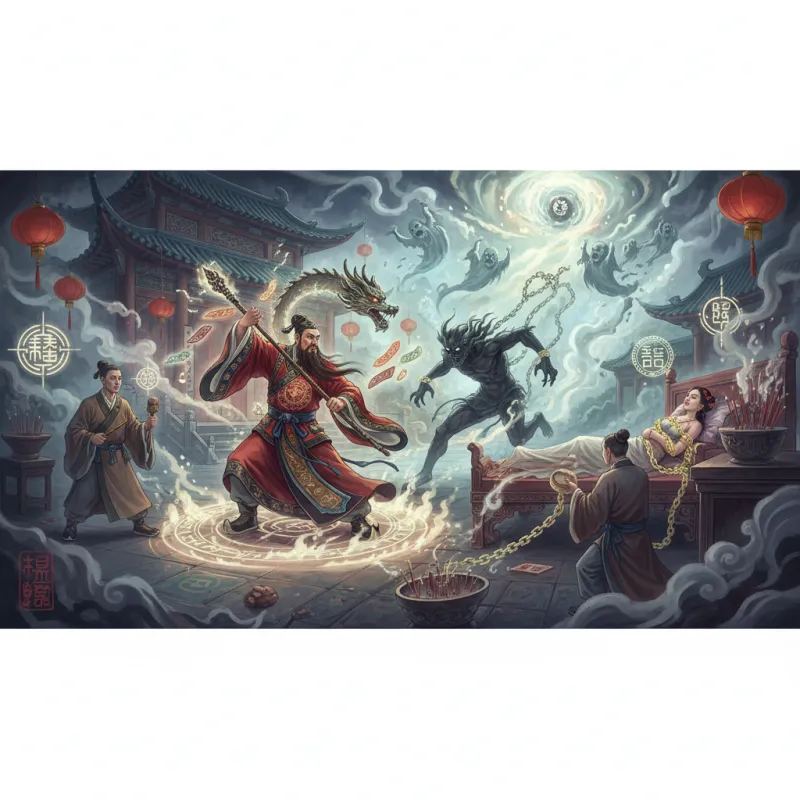
The priest's brush moves across yellow paper with practiced precision. Each stroke of cinnabar ink isn't just calligraphy—it's a legal document being filed with the celestial bureaucracy. In the corner of the room, something invisible hisses and retreats. This isn't spiritual warfare. This is paperwork that demons actually fear.
The Cosmic Filing System
Daoist exorcism (驱邪, qū xié) operates on a principle that would make any government administrator nod in recognition: the universe runs on proper procedure. While Western exorcism pits faith against demonic will in dramatic confrontations, Daoist priests approach possession like celestial lawyers handling a jurisdictional dispute. The demon isn't an agent of ultimate evil—it's an entity that's violated cosmic regulations, overstepped its authority, or simply ended up haunting the wrong household.
The Daoist priest (道士, dàoshi) doesn't primarily rely on personal spiritual power. He wields something more potent: the authority of heaven's administrative hierarchy. Every talisman (符, fú) he writes is essentially a formal complaint filed with higher management. Every ritual gesture invokes specific celestial officials who outrank the offending spirit. The demon must comply not because it's been overpowered, but because it's been served with legitimate paperwork from a higher authority.
This bureaucratic model reflects how traditional Chinese society understood power itself. Just as earthly officials derived authority from the emperor's mandate, spiritual entities operated within a hierarchy that extended from the Jade Emperor (玉皇大帝, Yùhuáng Dàdì) down through countless departments, each with specific jurisdictions. A demon causing trouble in someone's home is like a low-level clerk who's wandered into the wrong office—annoying, potentially dangerous, but ultimately subject to proper administrative channels.
The Arsenal: More Than Just Yellow Paper
Walk into a Daoist exorcism and you'll see tools that look like they belong in a calligrapher's studio mixed with a magistrate's office. The most iconic is the peachwood sword (桃木剑, táomù jiàn)—not because peachwood has inherent demon-slaying properties, but because it represents the authority to execute celestial commands. The priest doesn't stab the demon; he uses the sword to "cut" through spiritual barriers and seal off escape routes, like a bailiff blocking the courthouse doors.
Then there are the talismans themselves. These aren't random mystical symbols. Each character on a properly written talisman corresponds to specific celestial officials, departments, and legal codes. A talisman for expelling a hungry ghost (饿鬼, èguǐ) will invoke different authorities than one for dealing with a fox spirit (狐狸精, húlijīng) that's overstayed its welcome. The priest must know which celestial department has jurisdiction over which type of entity—get it wrong, and it's like filing your complaint with the Department of Motor Vehicles when you needed the Health Department.
The ritual mirror (法镜, fǎjìng) serves as both diagnostic tool and weapon. Demons can disguise themselves, but their true forms appear in the mirror's reflection. More importantly, the mirror can "capture" a spirit's image, essentially creating evidence for the celestial case file. Some priests use it to literally reflect demonic energy back at its source—a bureaucratic "return to sender" stamp on unwanted spiritual mail.
Incense isn't just atmospheric. Different types of incense attract different celestial officials, like sending up smoke signals to specific departments. Sandalwood might summon generals from the celestial army, while other blends call upon civil administrators. The priest is essentially saying, "I need someone from enforcement here, not just a clerk."
The Ritual: Filing a Celestial Lawsuit
A proper Daoist exorcism follows a structure that mirrors legal proceedings. It begins with the priest establishing his credentials—not through personal holiness, but by invoking his ordination lineage and the authority granted to him by his sect. He's showing his license to practice, his authorization to file complaints on behalf of mortals.
Next comes the investigation phase. The priest must identify exactly what type of entity is causing problems and why it's there. Is this a deceased relative who died with unfinished business? A wandering ghost that stumbled into the wrong location? A demon that was deliberately sent by an enemy? Each scenario requires different paperwork. This is why Daoist priests spend years studying classifications of spirits—it's like learning case law.
Once the entity is identified, the priest writes the appropriate talisman. This is the formal complaint. It states the problem, cites the relevant cosmic regulations being violated, and requests specific action from specific celestial officials. The talisman might be burned (sending it up to heaven like filing electronically), placed on the afflicted person (like a restraining order), or posted at the location (like a notice of eviction).
The priest then performs a series of ritual gestures and recites specific texts. These aren't prayers in the Western sense—they're more like reading the charges aloud in court. He's formally notifying all parties of the proceedings. The hand gestures (手诀, shǒujué) aren't mystical—they're signatures and seals, the equivalent of a notary's stamp validating the documents.
Finally comes the enforcement phase. The priest might use his sword to "seal" the area, preventing the entity from returning. He might sprinkle blessed water or rice to create barriers. These aren't magical shields—they're the spiritual equivalent of police tape marking a restricted zone. The celestial officials he's invoked are now responsible for ensuring the demon complies with the eviction order.
When Demons Lawyer Up
Here's where it gets interesting: demons can contest the proceedings. A powerful entity might have its own claims to the location—perhaps it died there and considers it rightfully its territory. Maybe it was invited by a previous resident who made offerings. In these cases, the exorcism becomes a negotiation.
The priest might need to offer the entity something in exchange for leaving: ritual offerings, prayers for its eventual reincarnation, or even just formal recognition of its grievances. This isn't weakness—it's acknowledging that the entity has legitimate standing in the cosmic legal system. Some demons are actually in the right, from a bureaucratic perspective. They're owed something, and they're haunting people to collect.
Other times, the demon is simply too powerful for the priest's current level of authority to handle. This is like a local court realizing a case needs to go to a higher jurisdiction. The priest might need to call in colleagues with stronger credentials, or perform more elaborate rituals that invoke higher-ranking celestial officials. In extreme cases, he might need to petition the Jade Emperor himself—the supreme court of the spirit world.
The Strange Tales from a Chinese Studio (聊斋志异, Liáozhāi Zhìyì) includes several stories where Daoist priests fail because they misidentified the entity or invoked the wrong authorities. In one tale, a priest tries to expel what he thinks is a minor ghost, only to discover it's actually a powerful fox spirit with centuries of cultivation. His talismans are useless—he's filed paperwork with the wrong department. The fox spirit, amused by his incompetence, lets him live but ruins his reputation.
The Philosophy Behind the Paperwork
This bureaucratic approach to exorcism reflects deeper Daoist philosophy about the nature of reality. The universe isn't a battleground between absolute good and evil. It's an ordered system where everything has its place. Demons aren't inherently evil—they're beings that have lost their proper place in the cosmic order, like files that ended up in the wrong cabinet.
The goal isn't to destroy the demon but to restore order. Even malevolent entities serve a function in the grand scheme. Hungry ghosts remind the living to care for their ancestors. Fox spirits test human virtue. Demons that punish the wicked are actually performing a cosmic service. The priest's job is to ensure these entities operate within their proper jurisdictions and don't harm innocent people.
This is radically different from Western exorcism, where demons are fallen angels in rebellion against God. In the Daoist view, there's no cosmic rebellion—just entities that need to be reminded of the rules and returned to their proper stations. It's not spiritual warfare; it's cosmic human resources management.
The emphasis on written talismans also reflects Chinese culture's deep respect for the written word. In a society where literacy was power and official documents could determine life or death, the idea that properly written characters could command spirits made perfect sense. The priest's brush is mightier than any sword because it can issue orders that even demons must obey.
Modern Practice and Adaptation
Contemporary Daoist priests still perform exorcisms using these traditional methods, though the context has changed. In modern Taiwan and Hong Kong, you can find priests who maintain the old practices while adapting to urban environments. Instead of traveling to remote villages, they might perform rituals in apartment buildings. The demons haven't changed, but their haunting grounds have.
Some priests have even adapted their practice for the digital age. While they still write talismans by hand—the physical act of writing is part of what gives the talisman authority—they might use smartphones to coordinate with other priests or research specific types of entities. The bureaucratic model adapts well to modern technology; after all, filing complaints electronically is still filing complaints.
There's also been interesting cross-pollination with other traditions. Some priests incorporate elements from Buddhist exorcism practices, creating hybrid rituals that invoke both Daoist celestial officials and Buddhist protective deities. This isn't syncretism for its own sake—it's practical. If you're dealing with a particularly stubborn demon, why not file complaints with multiple departments?
The practice has also influenced popular culture in fascinating ways. Chinese horror films and novels often feature Daoist priests as protagonists, and they're usually depicted as competent professionals rather than holy warriors. They're the ghostbusters of Chinese supernatural fiction—skilled technicians who know the rules and how to exploit them. The Mr. Vampire film series from the 1980s popularized this image, showing priests as action heroes who defeat hopping vampires (僵尸, jiāngshī) through knowledge and proper procedure rather than raw spiritual power.
Learning the Trade
Becoming a Daoist exorcist isn't about having a spiritual calling—it's about apprenticeship and study. A student must learn to read classical Chinese, memorize hundreds of talismans, understand the celestial hierarchy, and master the physical techniques of ritual performance. It takes years, sometimes decades, to become proficient enough to handle serious cases.
The training resembles legal education more than seminary. Students study case histories, learn to identify different types of entities by their symptoms, and practice writing talismans until they can produce them quickly and accurately under pressure. They must memorize which celestial officials have jurisdiction over which matters, like law students learning which courts handle which cases.
There's also a strong emphasis on lineage. A priest's authority comes partly from his ordination within a legitimate Daoist sect, which traces its authority back through generations of masters. This is like being admitted to the bar—you can't just declare yourself a lawyer and start filing cases. The celestial bureaucracy recognizes only properly credentialed priests, and demons know the difference between a legitimate practitioner and a fraud.
Some sects maintain detailed records of successful exorcisms, creating a body of case law that students study. These records describe the entity, the symptoms it caused, which talismans were effective, and which celestial officials responded. It's practical knowledge accumulated over centuries, refined through trial and error.
Why This Matters
Understanding Daoist exorcism reveals something profound about how different cultures conceptualize the supernatural. Western exorcism assumes a cosmic war between good and evil, where demons are enemies to be defeated. Daoist exorcism assumes a cosmic bureaucracy where demons are problems to be processed through proper channels.
Neither approach is more "real" than the other—they're different frameworks for understanding and addressing spiritual disturbances. But the Daoist model offers something uniquely practical: the recognition that not all supernatural problems require dramatic confrontation. Sometimes you just need to file the right paperwork with the right authorities.
For anyone interested in Chinese ghost stories or traditional spiritual practices, Daoist exorcism provides a window into a worldview where the supernatural is neither wholly good nor wholly evil, but simply another aspect of reality that must be properly managed. The demons aren't going anywhere—they're part of the cosmic order. The priest's job is just to make sure they stay in their lane.
And if that requires filling out forms in triplicate with cinnabar ink on yellow paper? Well, that's just how the universe works.
Related Reading
- Exorcism in Chinese Culture: How to Get Rid of Ghosts (According to Tradition)
- Zhong Kui: The Demon Queller Who Failed His Exams
- Talismans and Fu: The Ancient Art of Paper Magic
- Modern Exorcism in Chinese Communities: When Ancient Rituals Meet the 21st Century
- Exploring Chinese Supernatural Folklore: Ghosts, Spirits, and Afterlife Beliefs
- Unveiling the Mysteries of Chinese Supernatural Folklore: Ghosts, Spirits, and Afterlife Beliefs
- The Cowherd and the Weaver Girl: China's Greatest Love Story
Explore Chinese Culture
- Explore ancient mythical creatures
- Explore Daoist exorcism traditions
- Explore Chinese folk beliefs and superstitions