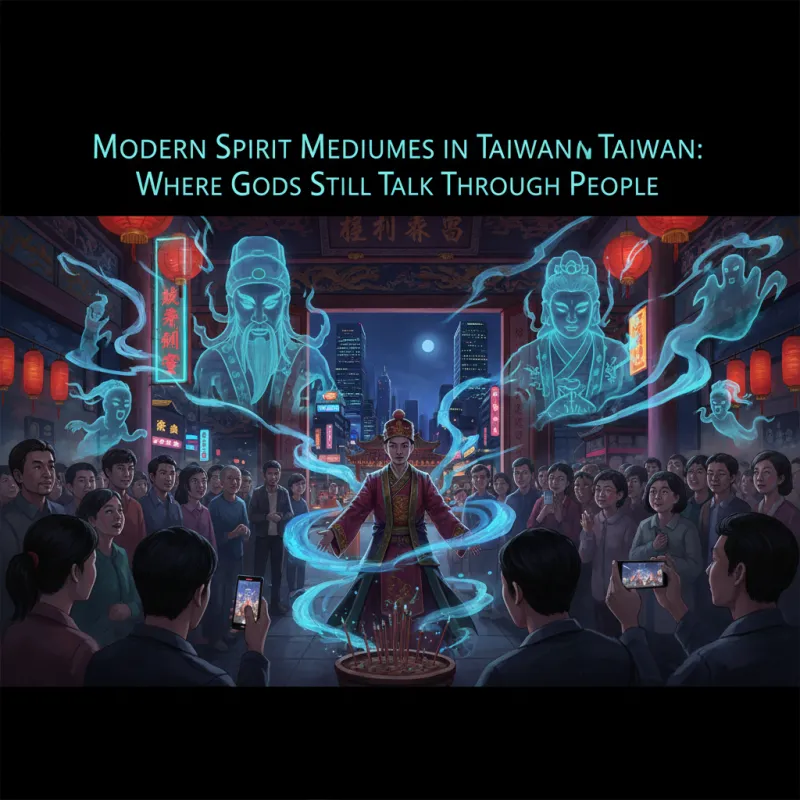
The fluorescent lights of a Taipei temple flicker as a middle-aged man in jeans and a polo shirt begins to shake. His eyes roll back. His body convulses. Then, suddenly, he's no longer himself — he's the Third Prince (三太子, Sān Tàizǐ), a child deity known for his fierce loyalty and supernatural power. The man, a software engineer by day, grabs a spiked ball attached to a chain and begins striking his back until blood flows. The crowd of worshippers — including doctors, lawyers, and university students — watches calmly. Some film it on their smartphones. This is just another Thursday night in modern Taiwan.
Taiwan hosts the world's most vibrant tradition of spirit mediumship in Chinese folk religion. With over 12,000 registered temples serving 23 million people, the island maintains roughly one temple for every 2,000 residents. But raw numbers don't capture what's truly remarkable: this is happening in one of Asia's wealthiest, most educated societies. Taiwan has universal healthcare, world-class universities, and manufactures most of the world's advanced semiconductors. The spirit mediums aren't relics of a fading past — they're busier than ever.
The Spirit Medium Tradition
Spirit mediums, called jītóng (乩童) or literally "divination youth," serve as vessels for deities to communicate directly with mortals. The practice has roots stretching back to ancient Chinese shamanism, but it flourished particularly in southern China and was carried to Taiwan by Hokkien and Hakka immigrants in the 17th and 18th centuries. Unlike the Daoist priests who perform rituals through learned liturgy, spirit mediums offer something more immediate and personal: direct conversation with the gods.
The process of becoming a medium typically begins with an involuntary calling. Future mediums often experience unexplained illnesses, vivid dreams, or behavioral changes that traditional medicine cannot address. They might hear voices, see visions, or feel compelled to visit specific temples. These symptoms are interpreted as a deity attempting to "recruit" them. Only after accepting the calling and undergoing proper training and initiation do the symptoms cease.
Once initiated, a medium enters trance states during temple ceremonies or private consultations. The deity "descends" (降神, jiàngshén) into the medium's body, temporarily displacing their consciousness. Different deities have distinct personalities and mannerisms — the Third Prince acts childish and playful, the Jade Emperor speaks with imperial authority, and Marshal Wen (溫元帥, Wēn Yuánshuài) displays military bearing. Regular worshippers can identify which deity has arrived simply by observing the medium's behavior.
The Performance of Pain
What shocks first-time observers is the violence. Many Taiwanese spirit mediums practice mortification rituals that would make medieval flagellants seem restrained. They strike themselves with spiked clubs, pierce their cheeks with skewers, cut their tongues with sword blades, and walk on burning coals. The blood is real. The wounds are real. Yet mediums claim to feel no pain while in trance, and their injuries reportedly heal with supernatural speed.
These displays aren't mere spectacle — they serve as proof of divine possession. The logic is straightforward: a human couldn't endure such punishment without supernatural assistance. The more extreme the self-mortification, the more powerful the deity being channeled. This creates a kind of spiritual arms race, with some mediums developing signature acts of endurance that become their calling cards.
The most common implement is the thorn ball (刺球, cìqiú) — a wooden sphere studded with nails attached to a handle or chain. Mediums strike their backs, shoulders, and sometimes foreheads with these weapons, drawing blood that's considered spiritually potent. Worshippers collect cloths soaked in this blood as protective talismans. Some temples sell these blessed items, creating a economy around the medium's suffering.
Critics, both within and outside the religious community, question whether all mediums are genuinely in trance states or if some are simply skilled performers. The debate is old and unresolved. What's undeniable is that the practice continues to draw crowds and that many mediums maintain their practice for decades, suggesting either genuine belief or extraordinary commitment to the performance.
Modern Mediums, Ancient Gods
Walk into a contemporary Taiwanese temple during a festival, and you'll witness a collision of eras that somehow makes perfect sense. The spirit medium channels a deity that's been worshipped for over a thousand years, but he's wearing Nike sneakers under his ceremonial robes. Worshippers livestream the possession on Facebook. The temple's sound system blasts electronic music mixed with traditional drums. Someone's iPhone alarm goes off during the ritual. Nobody seems bothered.
This seamless integration of tradition and modernity extends to the mediums themselves. Many hold regular jobs — they're teachers, shop owners, taxi drivers, office workers. They perform their medium duties part-time, usually during temple festivals or by appointment. Some temples have multiple mediums on rotation, like a spiritual on-call schedule. The professionalization varies: some mediums accept donations but don't charge fixed fees, while others have published rate cards for different services.
The clientele has evolved too. While older worshippers still dominate, increasing numbers of young Taiwanese consult spirit mediums for guidance on career decisions, relationship problems, and business ventures. University students visit before major exams. Entrepreneurs seek divine approval before signing contracts. The questions posed to the gods have shifted from "Will my crops survive?" to "Should I accept this job offer in Singapore?"
Technology has amplified rather than diminished the practice. Temples maintain active social media accounts announcing when specific deities will be available for consultation. Some mediums offer remote consultations via video call, though this remains controversial — many believe physical presence is necessary for effective divine communication. YouTube channels document famous mediums, and viral videos of particularly dramatic possessions rack up millions of views.
The Psychology and Sociology
Academics have studied Taiwanese spirit mediumship extensively, offering various explanations for its persistence. Anthropologists note that mediums often come from working-class backgrounds and that possession provides social status and authority they might not otherwise achieve. Psychologists point to dissociative states and the power of suggestion. Sociologists emphasize the community-building function of temple networks.
But these explanations, while valid, don't fully capture why spirit mediumship thrives specifically in modern Taiwan rather than fading as the society developed. Part of the answer lies in Taiwan's unique history. The island experienced rapid modernization without the corresponding destruction of traditional institutions that occurred in mainland China during the Cultural Revolution. Temples weren't demolished; they were renovated. Folk practices weren't suppressed; they were preserved and even encouraged as markers of Taiwanese identity distinct from the mainland.
The democratic transition in the 1980s and 1990s further strengthened folk religion. As Taiwan developed its own political identity separate from China, local religious practices became expressions of cultural autonomy. Supporting your neighborhood temple and consulting its spirit medium became acts of community participation and cultural preservation. The gods of Taiwan, channeled through local mediums, became symbols of Taiwanese distinctiveness.
There's also a pragmatic element. Taiwan's economic success created new anxieties. The pressure to succeed in a competitive, globalized economy generates stress that modern institutions don't fully address. Psychotherapy exists but carries stigma. Spirit mediums offer an alternative: they provide personalized guidance, emotional support, and a sense that powerful forces are looking out for you. The advice they give — often practical and psychologically sound — comes with divine authority.
Controversies and Challenges
Not everyone celebrates Taiwan's spirit medium tradition. Critics within the Buddhist and Christian communities view it as superstition that exploits vulnerable people. Medical professionals worry about mediums who discourage followers from seeking proper healthcare, though most mediums now explicitly tell sick worshippers to see doctors. The government occasionally investigates temples for fraud or tax evasion, though prosecutions are rare and politically sensitive.
The most serious controversies involve mediums who abuse their authority. Cases have emerged of mediums sexually exploiting followers, embezzling temple funds, or making false promises about curing serious illnesses. These scandals damage the reputation of legitimate practitioners and fuel calls for stricter regulation. However, regulating religious practice in a democracy is complicated, and most proposals have stalled.
Within the tradition itself, debates rage about authenticity and standards. Older mediums complain that younger practitioners lack proper training and are motivated by money rather than genuine calling. Some temples have attempted to establish certification processes, but there's no central authority to enforce standards. The tradition remains decentralized and somewhat chaotic — which is perhaps part of its vitality.
The physical toll on mediums is another concern. Despite claims of supernatural healing, repeated self-injury causes cumulative damage. Older mediums often bear extensive scarring, and some develop chronic pain conditions. A few temples have moved away from extreme mortification practices, but this risks accusations of inauthenticity. The gods, after all, are supposed to be powerful enough to protect their vessels from harm.
The Future of Divine Communication
What happens to spirit mediumship as Taiwan continues to modernize? The pessimistic view holds that it's a generational phenomenon — as older believers die, younger Taiwanese will abandon these practices for more rational worldviews. Temple attendance will decline, mediums will retire without successors, and the tradition will become a tourist attraction rather than a living practice.
The evidence suggests otherwise. Temple festivals remain well-attended, with young people participating enthusiastically. New mediums continue to emerge, including some from educated, middle-class backgrounds. The practice has proven remarkably adaptable, incorporating new technologies and responding to contemporary concerns while maintaining its essential character. The gods still have things to say, and people still want to hear them.
Perhaps the real question isn't whether spirit mediumship will survive, but what form it will take. Already we see variations emerging: mediums who emphasize counseling over spectacle, temples that blend folk religion with Buddhist philosophy, and practitioners who frame their work in psychological rather than supernatural terms. The tradition is evolving, as it always has.
What remains constant is the human need for connection with something greater than ourselves, for guidance in uncertain times, and for community in an increasingly atomized world. Spirit mediums in Taiwan provide all three. They offer a direct line to the divine, practical advice for daily problems, and a gathering place for neighbors who might otherwise never meet. In a society that has everything material comfort can provide, they offer something money can't buy: the feeling that you're not alone, that powerful forces care about your fate, and that the universe has a plan.
The software engineer who channels the Third Prince will return to his office tomorrow, write code, attend meetings, and eat lunch at his desk. But tonight, he's a god, and the people who've come to see him believe it completely. That's the miracle of modern Taiwan — not that ancient practices survive, but that they thrive, adapting and persisting because they still serve essential human needs. The gods haven't left. They've just learned to navigate the modern world, one possessed medium at a time.
Related Reading
- Shamanism in Chinese Folk Religion: The Original Spirit Workers
- Spirit Mediums in Chinese Culture: The Living Who Speak for the Dead
- The Tongji: Spirit Mediums of Southeast Asia's Chinese Communities
- Spirit Writing: Fuji Divination and Messages from the Gods
- 10 Famous Fox Spirit Stories That Defined Chinese Supernatural Fiction
- The Chinese Afterlife Is a Bureaucracy (And That Tells You Everything)
- Dream Interpretation in Chinese Culture: When the Spirit Wanders at Night
Explore Chinese Culture
- Explore ancient mythical creatures
- Explore Daoist exorcism traditions
- Explore Chinese folk beliefs and superstitions