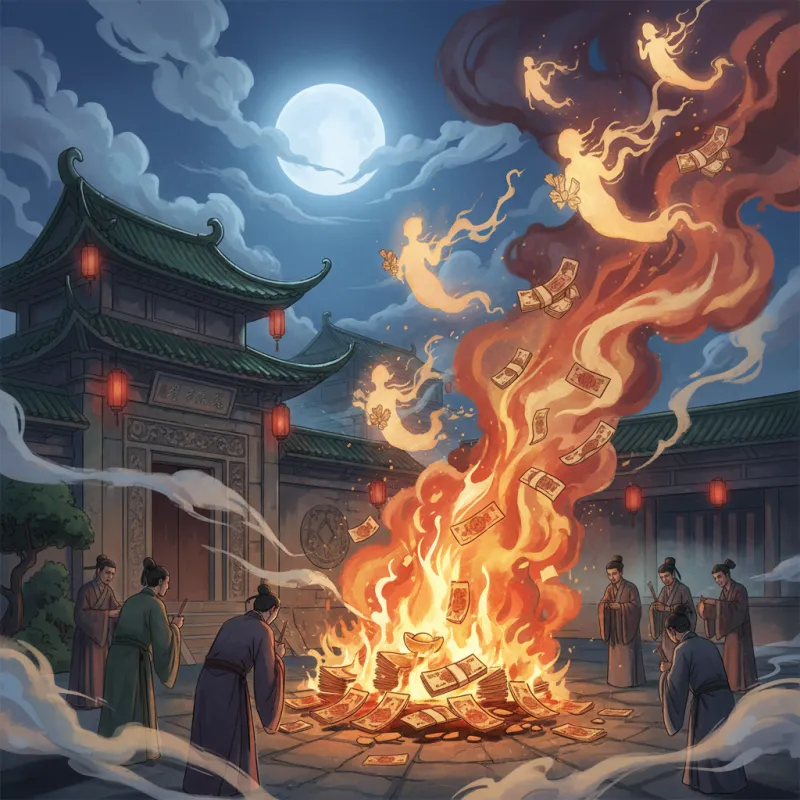
Walk through any Chinese neighborhood during the seventh lunar month and you'll smell it before you see it — the sharp, papery smoke of joss paper (纸钱, zhǐqián) burning in metal drums on sidewalks, in temple courtyards, at the edges of parking lots. Billions of dollars in fake currency, reduced to ash and sent to the dead.
To outsiders, it looks wasteful, superstitious, maybe a little dangerous (fire departments across Asia issue warnings every Ghost Month). To the people doing it, it's as practical as paying a utility bill. The dead need money. The living provide it. The delivery method is fire.
This isn't metaphor. In the Chinese cosmological system, the afterlife has an economy. The dead need to eat, need shelter, need to bribe officials (the underworld bureaucracy is modeled on the earthly one, complete with corruption). Without money, your deceased grandmother might be cold, hungry, or stuck in some administrative purgatory because she can't afford to grease the right palms. Burning joss paper is how you wire funds to the other side.
The Underworld Banking System
The logic is surprisingly consistent. If you accept that consciousness continues after death, and that the afterlife mirrors the living world in structure, then of course the dead need resources. Chinese folk religion doesn't promise a transcendent paradise where material needs vanish. It promises bureaucracy, hierarchy, and the same economic pressures you face now — just with different geography.
The system works through transformation. Physical objects burned in this world materialize in the next. The smoke carries the essence upward (or downward, depending on your cosmology). What looks like worthless paper here becomes legal tender there. It's a form of transdimensional commerce, with fire as the transaction medium.
This explains why joss paper designs have evolved with the times. Traditional versions featured simple gold or silver foil, representing ancient currency. Modern versions print denominations in the millions, billions, even trillions — Hell Bank Notes (冥币, míngbì) issued by the "Bank of Heaven and Earth." Some feature the Jade Emperor's portrait where earthly currency would show a president or monarch. The inflation is intentional. If your ancestor is competing in an afterlife economy with everyone else's well-funded dead relatives, you need to send serious money.
The practice has expanded beyond currency. Shops now sell paper versions of houses, cars, smartphones, designer handbags, even mistresses (controversial, but available). Burn it, and your deceased father gets it. The paper iPhone comes with paper AirPods. The paper mansion includes paper servants. It's Amazon Prime for the afterlife, with a 100% delivery guarantee via combustion.
Historical Roots and Evolution
Joss paper burning dates back at least to the Han Dynasty (206 BCE – 220 CE), though the practice likely predates written records. Early versions involved burning actual valuables — silk, food, even weapons — to accompany the dead. Archaeological evidence from tombs shows this wasn't symbolic; people genuinely believed these items transferred to the afterlife.
The shift to paper representations came later, probably during the Tang Dynasty (618-907 CE), when paper became cheaper and more available. It was an economic innovation as much as a religious one. Why burn real gold when paper gold accomplishes the same spiritual transaction? The dead can't tell the difference, and the living save money. Everyone wins.
Buddhist influence shaped the practice significantly. Buddhism introduced the concept of merit transfer — that actions by the living could improve conditions for the dead. This merged with existing ancestor veneration to create a system where burning offerings became a form of karmic banking. You're not just sending money; you're generating merit that improves your ancestor's status in the afterlife hierarchy.
The practice intensified during the Song Dynasty (960-1279 CE), when the concept of the Ten Courts of Hell became standardized. Each court had judges, clerks, and enforcers who determined a soul's fate. Like any bureaucracy, it could be influenced. Bribes helped. Burning money for the dead wasn't just charity; it was legal defense funding for their trial in the underworld courts.
The Mechanics of Burning
There's a protocol to this. You don't just light paper on fire and walk away. Proper joss paper burning follows specific rules, varying by region and family tradition, but certain elements remain consistent.
Timing matters. The seventh lunar month, known as Ghost Month, is peak season. The gates of the underworld open, spirits roam freely, and they're especially receptive to offerings. But burning happens year-round — at funerals, on death anniversaries, during Qingming Festival (清明节, Qīngmíng Jié), and whenever a family member feels their ancestor might need something.
Location matters. Burning at the grave site is ideal — direct delivery. Temple courtyards work because they're spiritually charged spaces with good reception, so to speak. Street corners are acceptable, especially if you call out the ancestor's name to ensure proper routing. Some families burn in metal drums at home, though this is increasingly restricted in urban areas due to fire codes and air quality concerns.
The burning itself requires focus. You're not disposing of trash; you're conducting a transaction. Many people recite the ancestor's name, state what they're sending, and specify the intended use. "Grandmother, this is for your living expenses." "Father, use this to buy a better house in the underworld." The verbal component ensures the spiritual postal service delivers to the right address.
Quantity varies by occasion and family wealth. A regular offering might be a few stacks of Hell Bank Notes. A funeral might involve burning enough paper money to fill garbage bags, plus paper houses, cars, and servants. The more you burn, the better equipped your ancestor is for afterlife challenges. It's conspicuous consumption extended beyond death.
Modern Adaptations and Controversies
The practice has globalized with Chinese diaspora communities. In San Francisco, Vancouver, Sydney, and London, you'll find joss paper burning during Ghost Month, adapted to local regulations. Some cities have designated burning areas. Others ban it entirely, forcing families to use electric incinerators or travel to less restricted locations.
Environmental concerns are real. Burning paper releases particulate matter and carbon dioxide. During peak periods, air quality in some Asian cities measurably worsens. Hong Kong, Singapore, and parts of mainland China have implemented restrictions or promoted alternatives like electronic joss paper burning — digital offerings sent via smartphone apps. Traditionalists hate this. How can a digital transaction reach the spirit world? The dead don't have WiFi.
The counterargument is pragmatic: if the afterlife has kept pace with earthly development (hence paper smartphones), why wouldn't it have digital infrastructure? If you accept that paper money works because of symbolic transformation, why wouldn't a digital symbol transform equally well? The debate reveals tensions between tradition and modernity, between literal and metaphorical interpretations of the practice.
Younger generations participate less, or participate differently. Some see it as superstition, incompatible with modern rationality. Others maintain the practice but reinterpret it — burning as memorial ritual rather than actual economic transaction, a way to remember the dead rather than provision them. The smoke becomes metaphor again, which is exactly what traditionalists fear.
Yet the practice persists, even thrives. Joss paper shops do steady business. New products appear constantly — paper credit cards, paper passports for ancestors who want to travel in the afterlife, paper diplomas for ancestors who never got educated in life. The market responds to demand, and demand remains strong.
The Psychology of Burning Money
There's something deeply satisfying about burning joss paper, even if you're not entirely sure you believe in its efficacy. The act is concrete, visible, irreversible. You're doing something for the dead, not just thinking about them or feeling sad. In a world where grief is often abstract and helpless, burning money provides agency.
It's also expensive, which matters psychologically. Free rituals feel cheap. Spending money — even on paper money you'll burn — signals genuine sacrifice. You're giving up resources, time, and effort. The dead, if they're watching, can see you care enough to invest. If they're not watching, you've still demonstrated commitment to family and tradition, which has social value.
The communal aspect reinforces participation. Burning joss paper is often a group activity, especially during festivals. Families gather, neighbors join in, and the shared ritual creates bonds among the living while honoring the dead. You're not just maintaining a relationship with your ancestors; you're maintaining relationships with your living relatives who also burn offerings.
For many practitioners, the question of literal belief is beside the point. Does the money actually reach the dead? Maybe, maybe not. But the ritual serves functions regardless: it structures grief, maintains cultural identity, creates family cohesion, and provides a sense of control over the uncontrollable fact of death. The smoke rises, the paper burns, and something intangible but real happens in the hearts of those watching.
Joss Paper in Chinese Horror and Folklore
Joss paper appears constantly in Chinese ghost stories, usually as a plot device revealing supernatural presence. In the classic tale "The Painted Skin" (画皮, Huàpí), a demon disguises itself as a beautiful woman, and one telltale sign is that money given to it transforms into joss paper — currency of the dead, useless to the living. The transformation reveals the creature's true nature.
Modern horror films use joss paper as atmospheric shorthand for supernatural danger. Scattered joss paper on a street at night signals ghost activity. A character finding joss paper in their pocket suggests they've been marked by spirits or have unknowingly crossed into the spirit world. The paper becomes a boundary marker between realms.
There are stories of people who accidentally pick up joss paper thinking it's real money, only to discover the transformation later — usually with unfortunate consequences. The dead don't appreciate theft. Other tales feature ghosts who appear at joss paper shops, buying supplies for themselves, paying with money that turns to leaves or paper after they leave. These stories reinforce the paper's liminal status, belonging to neither world completely but connecting both.
The hungry ghosts of the seventh month are particularly associated with joss paper. These are spirits with no living descendants to burn offerings for them, condemned to wander hungry and desperate. Burning joss paper during Ghost Month isn't just for your own ancestors; it's charity for these forgotten dead, preventing them from causing trouble out of desperation. It's supernatural welfare, funded by the living.
The Future of Burning
Will people still burn joss paper in fifty years? A hundred? The practice has survived for over two millennia, adapting to Buddhism, Taoism, Confucianism, communism, capitalism, and globalization. It's proven remarkably resilient.
But the pressures are real. Urbanization makes burning difficult. Environmental regulations restrict it. Younger generations are less convinced. Digital alternatives offer convenience without smoke. The practice might evolve into something unrecognizable to current practitioners, or it might disappear entirely in some regions while intensifying in others.
What seems certain is that as long as people grieve, they'll seek ways to maintain connection with the dead. Whether that connection requires actual fire and paper, or whether it can be satisfied through digital simulation or pure symbolism, remains to be seen. The underlying need — to care for those who've died, to feel we can still help them somehow — that need isn't going anywhere.
The smoke will keep rising, in one form or another. The dead will keep needing what the living can provide. And somewhere, in temple courtyards and on street corners, someone will light paper on fire and watch it burn, sending wealth to ancestors who may or may not be waiting to receive it, maintaining a tradition that makes death a little less final and grief a little more bearable.
The transaction continues. The economy of the afterlife remains open for business. And the living keep burning money for the dead, because some debts transcend death, and some gifts can only be delivered through flame.
Related Reading
- Unveiling Chinese Supernatural Folklore: Ghosts, Spirits, and Afterlife Beliefs
- Qingming Festival: When China Visits Its Dead
- Ancestor Worship: The Living Relationship with the Dead
- Chinese Death Customs That Surprise Westerners
- Chinese Funerals: A Complete Guide to Death Customs and Rituals
- The Drowning Ghost (水鬼): China's Most Feared Water Spirit
- Unveiling the Secrets of Chinese Supernatural Folklore and Afterlife Beliefs
- Unraveling the Mystique of Chinese Supernatural Folklore and Afterlife Beliefs
Explore Chinese Culture
- Explore ancient mythical creatures
- Explore Daoist exorcism traditions
- Explore Chinese folk beliefs and superstitions