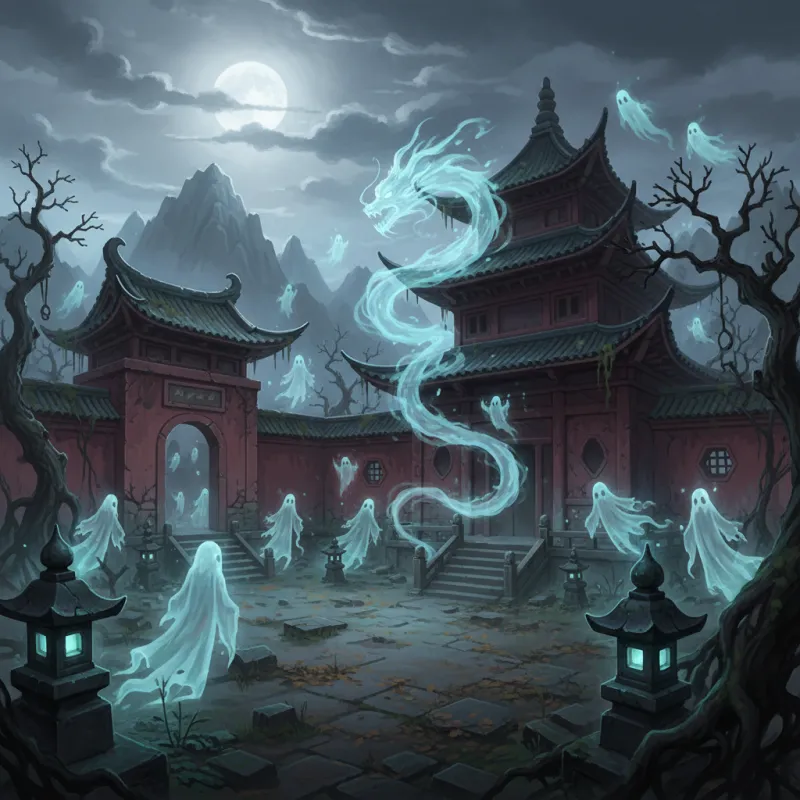
The bell at Famen Temple rings at 3 AM every night, though the rope was cut down in 1987. Monks who've tried to investigate find themselves unable to enter the bell tower after midnight — not because of locked doors, but because their legs simply refuse to climb the stairs. "Your body knows better than your mind," one elderly monk told me. "The tower belongs to someone else during those hours."
This is the paradox of sacred space in China: temples don't repel ghosts. They attract them.
The Economics of Haunting: Why Spirits Choose Temples
Think of temples as spiritual infrastructure — they're built on power nodes, designed with feng shui precision to channel qi (气, life force) between heaven and earth. A temple is essentially a cosmic subway station, and like any transit hub, it attracts all kinds of travelers. The difference between a "blessed" temple and a "haunted" one often comes down to maintenance and management.
The 清代 (Qing Dynasty) scholar 纪昀 (Jì Yún) documented this phenomenon extensively in his 阅微草堂笔记 (Yuèwēi Cǎotáng Bǐjì, Notes from the Yuewei Hermitage). He recorded dozens of cases where temples became haunted not because of some ancient curse, but because of simple neglect. When daily rituals lapse, when incense offerings stop, when protective talismans fade — the spiritual "security system" goes offline. The crossing point remains open, but nobody's checking who comes through.
This explains why newly abandoned temples are often more dangerous than ancient ruins. A temple that's been empty for centuries has usually reached some kind of equilibrium with its spirit residents. But a recently abandoned temple? That's like leaving your front door open in a busy neighborhood and wondering why strangers keep walking in.
Puning Temple: The Hungry Ghost Who Wouldn't Leave
Puning Temple (普宁寺, Pǔníng Sì) in Chengde should be one of the safest temples in China. Built in 1755 by the Qianlong Emperor, it houses a 22-meter tall statue of Guanyin and maintains active worship to this day. Yet the western courtyard has been closed to visitors since 1993, officially for "structural repairs" that have now lasted three decades.
The unofficial story involves a hungry ghost (饿鬼, èguǐ) that attached itself to a corrupt monk in the 1980s. The monk had been skimming money from temple donations, and according to local accounts, he began to waste away despite eating constantly. He would wake up screaming about a woman with a distended belly who sat on his chest at night, demanding to be fed. The monk died within six months, but the presence didn't leave with him.
Subsequent monks assigned to the western courtyard reported the same phenomenon: an overwhelming hunger that no amount of food could satisfy, and dreams of a skeletal woman who whispered, "Feed me what you stole." The temple's solution was pragmatic — they sealed off the courtyard, perform monthly feeding rituals at the boundary, and simply work around the problem. The hungry ghost gets her offerings, and everyone else stays safe.
This is very Chinese approach to haunting: not exorcism, but accommodation. The ghost has a legitimate grievance (the stolen donations), so she gets permanent resident status and regular meals. Problem solved.
The Pagoda Principle: Vertical Hauntings
Pagodas present a unique haunting challenge because they're designed to trap and transform negative energy. The architectural logic is brilliant: evil qi rises (like heat), so you build a tall structure to catch it, then use Buddhist sutras and sacred geometry to neutralize it as it spirals upward. A functioning pagoda is essentially a spiritual air purifier.
But when a pagoda falls into disrepair, you've got a tower full of trapped, concentrated negative energy with nowhere to go. The Leifeng Pagoda (雷峰塔, Léifēng Tǎ) in Hangzhou collapsed in 1924, and locals reported that the dust cloud that rose from the ruins was "the wrong color" — a greenish-gray that hung in the air for hours. Some claimed to see faces in the cloud. The pagoda had stood for nearly a thousand years, and when it finally fell, everything it had been containing was released at once.
The modern reconstruction (completed in 2002) is built around the original ruins, which remain sealed in the foundation. Smart move. You don't disturb a thousand years of accumulated spiritual residue unless you absolutely have to.
The White Horse Temple (白马寺, Báimǎ Sì) in Luoyang has a similar situation with its Qiyun Pagoda. The top three floors have been closed since the 1960s, officially due to "structural concerns." But maintenance workers report that tools left on the upper floors overnight are found rearranged in the morning — not scattered randomly, but arranged in deliberate patterns. Hammers placed in circles. Nails lined up to point toward the center of the room. Someone, or something, is still performing rituals up there.
Fengdu Ghost City: When the Haunting Is the Point
Fengdu Ghost City (丰都鬼城, Fēngdū Guǐchéng) deserves special mention because it's the only place in China where being haunted is the entire business model. This complex of temples and shrines on the Yangtze River has been dedicated to the afterlife for over 2,000 years. It's essentially the Chinese underworld's administrative headquarters in the mortal realm.
The fascinating thing about Fengdu is that it's not scary in the way abandoned temples are scary. It's scary in the way a functioning courthouse is intimidating — you're not worried about random violence, you're worried about bureaucratic judgment. The temples here are dedicated to the various departments of the underworld: the Hall of Judgment, the Bridge of Helplessness, the Tower of Last Glances. Everything is organized, official, and terrifying in its efficiency.
Visitors report feeling "watched" but not threatened. It's the sensation of being in a space where you're the outsider, where the primary residents are going about their business and you're just a tourist in their world. The ghosts at Fengdu aren't haunting the place — they work there. You're the one who's out of place.
The temple complex was partially relocated in 2009 due to the Three Gorges Dam project, and there was genuine concern about whether the spiritual infrastructure would survive the move. You can't just pick up the underworld's filing system and drop it somewhere else. But the priests performed elaborate transfer rituals, essentially "forwarding the mail" to the new location, and so far, it seems to have worked. The new Fengdu feels just as officially ominous as the old one.
The Monk Who Stayed: Voluntary Hauntings
Not all temple ghosts are tragic or malevolent. Some are simply monks who liked their job so much they refused to quit, even after death. The Shaolin Temple (少林寺, Shàolín Sì) has several of these — deceased masters who still patrol the training grounds at night, correcting the stances of students who practice late.
One famous case involves a monk named Hai Deng (海灯法师, Hǎidēng Fǎshī), who died in 1989. Students training in the early morning hours report seeing an elderly monk watching from the doorway of the practice hall, nodding approval or shaking his head at poor form. When they approach, he's gone. The description always matches Hai Deng, down to his distinctive posture and the way he held his hands behind his back while observing.
The temple's attitude toward this is essentially: "If Master Hai Deng wants to keep teaching, who are we to stop him?" There's no exorcism, no attempt to "help him move on." He's not trapped or suffering — he's just continuing his work. This is the Buddhist version of emeritus status.
The same phenomenon occurs at Lingyin Temple (灵隐寺, Língyǐn Sì) in Hangzhou, where the library is said to be frequented by a scholarly monk who died in the 1930s. Books are found re-shelved in better organizational systems. Manuscripts left out overnight are discovered with corrections in the margins — always accurate, always in classical Chinese calligraphy. The current librarian keeps a notebook where he writes questions about obscure texts, and sometimes finds answers written below his questions in that same antique hand.
Living With Ghosts: The Practical Theology of Haunted Temples
Modern temple management has developed sophisticated protocols for dealing with supernatural residents. It's less exorcism, more property management. The key is establishing clear boundaries and maintaining regular communication through ritual.
At Guangxiao Temple (光孝寺, Guāngxiào Sì) in Guangzhou, there's a courtyard that belongs to a female ghost who died during the temple's construction in the 4th century. She's not malevolent, but she's territorial. The solution: that courtyard is designated as "her" space. Monks don't use it for regular activities, but they maintain it carefully and leave offerings on the first and fifteenth of each lunar month. In exchange, she doesn't wander into other parts of the temple. It's essentially a lease agreement with a very long-term tenant.
This pragmatic approach reflects a deeper Chinese understanding of the supernatural: ghosts aren't necessarily evil, they're just dead people with unfinished business or strong attachments. You wouldn't automatically evict a living person just for being inconvenient, so why treat ghosts differently? If they're not causing harm, if their presence can be managed through ritual and respect, then coexistence is preferable to conflict.
The exception, of course, is when ghosts become actively dangerous — usually because they're suffering or angry. Then you need specialists. But even exorcism in Chinese Buddhism is less about banishment and more about resolution. You're trying to address the ghost's grievance, help them let go of their attachment, and guide them toward rebirth. It's therapy, not warfare.
The Future of Haunted Temples
As China modernizes, the relationship between temples and their supernatural residents is changing. Some temples are leaning into their haunted reputations for tourism purposes, which makes traditional monks deeply uncomfortable. There's a difference between respectfully acknowledging spiritual residents and turning them into entertainment.
Other temples are becoming more secretive about their hauntings, worried that publicity will attract ghost hunters and paranormal investigators who don't understand the protocols. A haunted temple isn't a theme park — it's a functioning religious site that happens to have non-corporeal residents. Treating it like a tourist attraction can destabilize carefully maintained spiritual agreements.
The most interesting development is the emergence of young monks who are trying to document temple hauntings using modern technology, while still maintaining traditional respect. They're not trying to "prove" ghosts exist — they're trying to better understand the patterns of spiritual activity so they can maintain the temples more effectively. It's a fascinating blend of ancient practice and contemporary methodology.
What remains constant is the fundamental truth that drew me to this topic: in China, the most sacred spaces are often the most haunted. Not because holiness attracts evil, but because temples are designed to be crossing points between worlds. The ghosts aren't invading sacred space — they're using it exactly as it was intended, as a bridge between the living and the dead, the mortal and the divine.
The bell at Famen Temple will keep ringing at 3 AM. The monks will keep refusing to climb those stairs after midnight. And somewhere in the darkness of that bell tower, someone — or something — will keep pulling a rope that isn't there, marking the hours in a time that belongs to neither the living nor the fully dead, but to that liminal space where Chinese temples have always specialized: the border between worlds, where the crossing is always open, and someone is always watching the gate.
Related Reading
- Temple Guardian Spirits: The Supernatural Protectors of Sacred Spaces
- Temple Legends: The Ghost Stories That Live in China's Sacred Spaces
- Haunted Temples: Where Gods and Ghosts Coexist
- Cursed Objects in Chinese Folklore: Things You Should Never Touch
- Exploring Chinese Supernatural Folklore: Ghosts, Spirits, and Afterlife Beliefs
- The Most Famous Chinese Ghost Stories: Tales That Have Haunted a Civilization
- Daoist Exorcism: How Chinese Priests Fight Supernatural Evil
Explore Chinese Culture
- Explore ancient mythical creatures
- Explore Daoist exorcism traditions
- Explore Chinese folk beliefs and superstitions