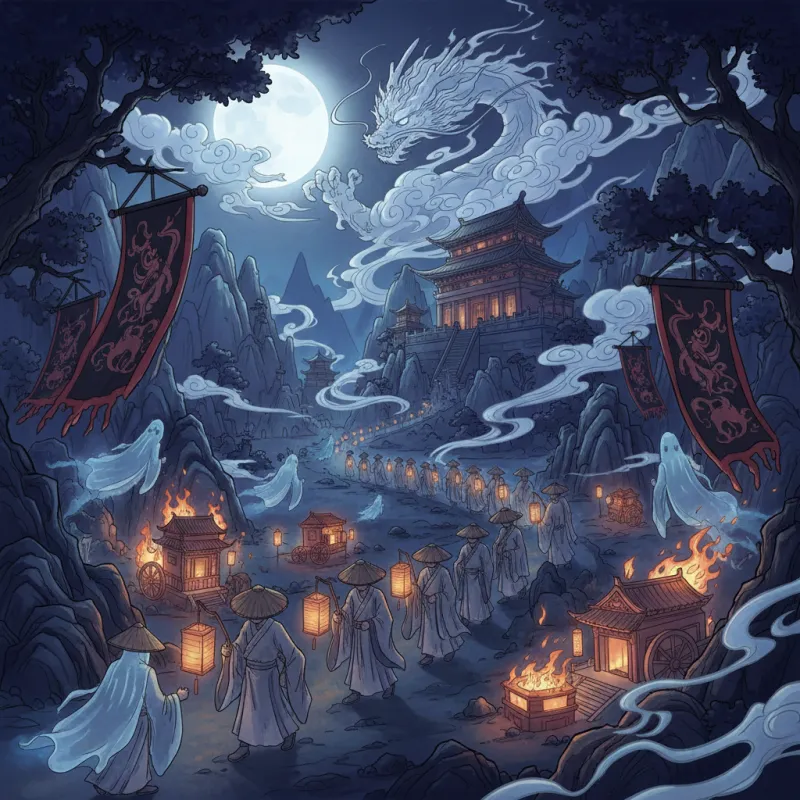
The mourning wail that echoes through a Chinese funeral home is not grief alone — it is a calculated performance designed to convince underworld bureaucrats that the deceased was properly loved. Cry too softly, and the judges of 阴间 (yīnjiān, the underworld) might assume the family didn't care. Cry too theatrically, and you risk appearing insincere. This delicate balance between genuine emotion and ritual obligation defines every aspect of Chinese funeral customs, where death is not an ending but a dangerous bureaucratic transition that requires meticulous paperwork, spiritual currency, and the right connections in the afterlife.
The Soul's Fragmentation and the Race Against Time
Chinese cosmology doesn't recognize a single unified soul. Instead, each person possesses 魂 (hún) — the ethereal soul that ascends — and 魄 (pò) — the corporeal soul that descends with the body. Some traditions further divide these into three 魂 and seven 魄, each with different destinations and vulnerabilities. The moment of death fractures this spiritual unity, and the funeral's primary purpose is managing this fragmentation before malevolent entities exploit the chaos.
The first critical hours after death are governed by strict protocols. The body must not be moved immediately — doing so risks disorienting the 魂, which hovers near the corpse in confusion. Family members place a white cloth over the face and light incense to guide the soul. In traditional practice, a Daoist priest performs the 招魂 (zhāohún) ritual, literally "summoning the soul," by climbing onto the roof with the deceased's clothing and calling their name toward the direction of their birthplace. This isn't superstition — it's emergency spiritual retrieval before the soul wanders into dangerous territory.
Meanwhile, the family begins the elaborate notification process. They must inform both the living community and the dead. A white cloth banner hung outside the home announces the death to neighbors. But more importantly, they must notify the ancestors through offerings at the family altar, essentially filing a death certificate with the spiritual bureaucracy. The City God — the local administrator of the underworld — must also be informed through temple offerings, as he maintains jurisdiction over all souls in his territory.
The Funeral as Underworld Trial Preparation
Chinese funerals are not memorial services — they are legal defense preparations for the deceased's upcoming trial in the underworld. According to traditional belief, every soul must appear before the 十殿阎王 (shí diàn yánwáng, Ten Courts of Hell) where judges review the life record and assign the next incarnation. The funeral's ritual components serve as evidence of good character, family devotion, and proper social standing.
This explains the prominence of 纸钱 (zhǐqián, paper money) and elaborate paper offerings. Families burn vast quantities of 冥币 (míngbì, underworld currency), paper houses, cars, servants, and even paper smartphones in recent years. Western observers often dismiss this as quaint folk practice, but the logic is ruthlessly practical: the deceased needs resources to bribe underworld officials, pay for legal representation, and maintain dignity during the trial process. A soul arriving in 阴间 without funds is like a defendant showing up to court without a lawyer — technically possible, but strategically disastrous.
The funeral also serves as character witness testimony. Professional mourners may be hired not just for show, but to create an audible record of the deceased's popularity and virtue. The more people who attend, the more offerings presented, the more elaborate the ceremony — all of this generates spiritual evidence that underworld judges supposedly consider. In imperial times, officials' funerals were graded by rank, with specific numbers of mourners, musicians, and ritual objects required. This wasn't vanity; it was ensuring the deceased had proper documentation for the afterlife bureaucracy.
Buddhist and Daoist priests perform different but complementary functions during the funeral. Daoist priests focus on the administrative aspects — filing the proper spiritual paperwork, ensuring the soul has correct transit documents, and performing rituals that essentially notarize the death for underworld authorities. Buddhist monks, meanwhile, conduct 超度 (chāodù) ceremonies to reduce the deceased's karmic debt through sutra recitation, effectively providing spiritual legal aid to improve the trial outcome.
The Coffin, The Vigil, and The Dangerous Threshold
The coffin in Chinese tradition is not merely a container — it is a temporary dwelling that must be made comfortable and secure. Wealthy families historically commissioned coffins years in advance, storing them as prized possessions. The wood matters: 楠木 (nánmù, nanmu wood) and 柏木 (bǎimù, cypress) are preferred for their durability and pleasant scent, but also for their spiritual properties in preserving the 魄 and preventing it from becoming a 僵尸 (jiāngshī, hopping vampire).
Before the body is placed in the coffin, it undergoes ritual cleansing performed by family members of the same gender. This isn't about hygiene — it's about purification for the journey ahead. The body is dressed in burial clothes, traditionally including multiple layers with specific symbolic colors. Red is absolutely forbidden, as it might attract the attention of malevolent spirits or cause the deceased to return as a vengeful ghost. The number of layers must be odd for men, even for women, following 阴阳 (yīnyáng) principles.
Inside the coffin, the family places items the deceased will need: favorite foods, personal objects, and crucially, a small amount of rice and coins in the mouth. The rice ensures the soul won't go hungry during the journey to the underworld. The coins — traditionally seven, representing the seven 魄 — serve as ferry payment for crossing the 奈何桥 (Nàihé Qiáo), the Bridge of Helplessness that spans the boundary between the living world and the underworld. Without this payment, the soul becomes stranded, potentially transforming into a hungry ghost condemned to eternal wandering.
The vigil period, typically lasting several days to weeks depending on the deceased's status, is when the family is most vulnerable to supernatural interference. The corpse is a spiritual beacon, attracting entities that feed on death energy or seek to possess the abandoned body. This is why the vigil is never left unattended — family members rotate in shifts, maintaining constant watch. Incense burns continuously, not for ambiance but as a spiritual barrier. Mirrors in the room are covered because reflective surfaces can trap the hovering 魂 or allow it to see its own corpse, causing confusion and preventing proper departure.
During this period, family members wear 麻衣 (máyī, hemp mourning clothes) in white, the color of death and mourning in Chinese culture. The specific style and duration of mourning dress follows the 五服 (wǔfú) system, an elaborate hierarchy based on relationship proximity to the deceased. Children wear the coarsest hemp for the longest period; distant relatives wear finer materials for shorter times. This visible gradation serves both social and spiritual functions — it allows the deceased's soul to identify family members and understand the family structure it's leaving behind.
The Procession: Navigating the Spirit World Geography
The funeral procession is not a simple journey from home to grave — it is a carefully choreographed navigation through overlapping spiritual territories. The route must be planned to avoid certain locations: places where violent deaths occurred, crossroads where ghosts congregate, and areas under the jurisdiction of particularly strict local spirits. In traditional processions, a priest leads carrying a banner with the deceased's name and dates, essentially announcing to all spiritual entities that this soul is in authorized transit.
The procession order follows strict hierarchy. First comes the banner and portrait of the deceased. Then musicians playing mournful melodies — not for the living's benefit, but to announce the soul's passage to spirits along the route. Professional mourners follow, their wailing serving as both grief expression and spiritual announcement. The coffin comes next, carried by bearers who must be carefully selected — they cannot be people born in years that conflict with the deceased's zodiac sign, as this could cause spiritual friction that traps the soul.
Family members follow in order of the 五服 system, with the eldest son typically carrying a staff and leading the immediate family. In traditional practice, the eldest son also carries a clay pot that will be smashed at the grave site, symbolically breaking the deceased's attachment to the earthly home. Behind the family come friends, colleagues, and community members, their presence serving as witnesses to the proper completion of the funeral rites.
The procession may include elaborate paper constructions — houses, servants, vehicles — that will be burned at the grave. These aren't decorations; they're the deceased's moving truck, transporting their afterlife possessions to the new residence. In modern urban settings, these processions have been compressed or eliminated, but traditional families still insist on some form of procession, even if it's just circling the block, because skipping this step risks leaving the soul geographically confused about where it now resides.
Burial, Cremation, and the Feng Shui of Death
The grave site selection is perhaps the most critical decision in the entire funeral process, because Chinese belief holds that the deceased's resting place directly affects the living descendants' fortune. This is 阴宅风水 (yīnzhái fēngshuǐ, yin dwelling feng shui), and it's taken far more seriously than the feng shui of living spaces. Wealthy families hire expert geomancers to identify auspicious locations where the 气 (qì, vital energy) flows properly, ensuring the deceased rests comfortably and channels positive energy back to the family line.
The ideal burial site faces south, is backed by mountains, and fronts water — the classic feng shui formation. But it must also avoid 煞气 (shàqì, harmful energy) from nearby sources: other graves, temples, roads, or geological features that might disturb the 魄. The burial date and time are calculated using the deceased's birth data and the Chinese almanac to ensure cosmic alignment. Burying at the wrong time can trap the soul in the coffin or cause it to become a 厉鬼 (lìguǐ, malevolent ghost).
During burial, specific rituals ensure the soul understands this is its new residence. The grave is "opened" through ritual before the coffin is lowered, essentially notifying the earth spirits that a new resident is arriving. Offerings are made to the 土地神 (tǔdìshén, local earth god) requesting permission and protection. The coffin must be oriented correctly according to compass directions calculated for that specific individual. Once positioned, family members throw handfuls of earth onto the coffin, each handful representing their acceptance of the death and their commitment to remember the deceased.
Cremation, while increasingly common in modern China due to space constraints, was historically viewed with suspicion. The concern was that burning the body destroys the 魄's anchor, potentially leaving it homeless and vengeful. However, Buddhist influence gradually normalized cremation, reframing it as accelerating the soul's release from physical attachment. Modern cremation practices now include many traditional elements: the ashes are treated with the same respect as a body, placed in urns that function as miniature coffins, and interred with similar feng shui considerations.
After burial or cremation, the family performs 圆坟 (yuánfén), literally "completing the grave," three days later. They return to add more earth to the grave mound and make offerings, essentially conducting a follow-up inspection to ensure the deceased has settled properly. This isn't optional — skipping this step risks leaving the soul in a state of limbo, uncertain whether the burial was completed or if it should return home.
The Mourning Period and Feeding the Dead
The funeral ceremony's conclusion doesn't end the family's obligations — it begins a structured mourning period with specific duties at designated intervals. The first critical checkpoint is the 头七 (tóuqī), the seventh day after death, when the soul supposedly returns home one final time before fully transitioning to the underworld. Families prepare the home for this visit, leaving the deceased's favorite foods, opening doors and windows to allow easy entry, and sometimes scattering flour on the floor to capture footprints as proof of the visit.
The mourning period traditionally extends through multiple "sevens" — 二七, 三七, up to 七七 (qīqī, the 49th day), each marked by offerings and rituals. The 49-day period aligns with Buddhist belief about the soul's journey through intermediate states before rebirth. On each seventh day, the family makes offerings at the grave or home altar, essentially providing the deceased with supplies for their ongoing underworld trial and residence.
The 百日 (bǎirì, 100th day) and first anniversary are major milestones requiring substantial ceremonies. By the 100th day, the soul should have completed its initial underworld processing and received its preliminary judgment. The first anniversary marks the completion of the most intensive mourning period, though filial children traditionally observe three years of modified mourning for parents.
These ongoing rituals serve multiple purposes. They maintain the connection between living and dead, ensuring the deceased remains integrated in family consciousness. They provide continued support for the soul's underworld existence — think of it as sending care packages to someone in a foreign country. And critically, they prevent the deceased from becoming a forgotten ghost, which is one of the most dangerous spiritual states. A ghost with no living descendants to make offerings becomes a hungry ghost, desperate and potentially malevolent.
Modern Adaptations and Persistent Beliefs
Contemporary Chinese funerals, especially in urban areas, have compressed and modified traditional practices, but the underlying logic persists. Modern funeral homes offer package services that include professional mourners, ritual specialists, and even digital offerings — QR codes that allow remote attendees to burn virtual paper money. Yet even highly educated, cosmopolitan Chinese families often insist on certain non-negotiable elements: the proper orientation of the body, the coins in the mouth, the avoidance of red, the seventh-day observances.
This persistence isn't mere cultural conservatism. It reflects a pragmatic approach to death: why risk it? Even those who don't fully believe in underworld bureaucracy often follow the rituals "just in case," applying Pascal's Wager to funeral customs. The cost of performing the rituals is relatively small; the potential cost of not performing them — a restless ghost, family misfortune, karmic consequences — is catastrophically high.
The diaspora has created fascinating hybrid practices. Chinese communities in Southeast Asia, North America, and Europe adapt funeral customs to local regulations and available resources while maintaining core elements. You might see a funeral procession in San Francisco with a traditional banner and musicians, followed by a hearse instead of coffin bearers, ending at a crematorium where paper offerings are burned in a designated area. The form changes, but the function — safely transitioning the soul and protecting the living — remains constant.
What strikes me most about Chinese funeral customs is their refusal to sentimentalize death. There's grief, certainly, but it's channeled into practical action: filing the spiritual paperwork, providing resources, maintaining connections. Death isn't romanticized as "going to a better place" or euphemized into non-existence. It's treated as what it is — a dangerous transition requiring expertise, resources, and meticulous attention to detail. The deceased isn't "at peace" automatically; they're at the beginning of a complex journey, and the funeral is their send-off party, legal defense fund, and survival kit all in one.
Related Reading
- Chinese Death Customs That Surprise Westerners
- Unveiling Chinese Supernatural Folklore: Ghosts, Spirits, and Afterlife Beliefs
- Joss Paper: Burning Money for the Dead
- Ancestor Worship: The Living Relationship with the Dead
- Qingming Festival: When China Visits Its Dead
- The Most Haunted Temples in China: Ghost Stories from Sacred Ground
- The Nine-Tailed Fox: From Divine Symbol to Ultimate Villain
- The Nine-Tailed Fox: From Demon to Deity
Explore Chinese Culture
- Explore ancient mythical creatures
- Explore Daoist exorcism traditions
- Explore Chinese folk beliefs and superstitions