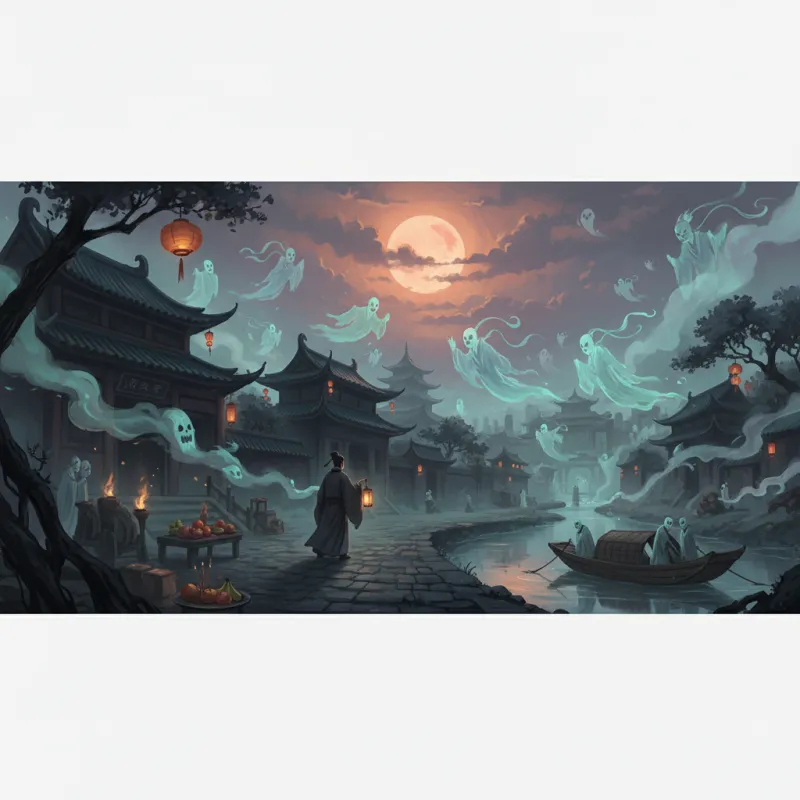
The elevator doors open on the fourteenth floor — except there is no fourteenth floor. In Taiwan's hospitals, hotels, and apartment buildings, the numbers jump from thirteen to fifteen. The fourth floor? Also missing. But during the seventh lunar month, you could skip every unlucky number in the building and it wouldn't matter. The ghosts are already inside.
Ghost Month (鬼月, guǐ yuè) isn't a festival. It's not a celebration. It's a thirty-day period when the boundary between the living and the dead dissolves, and the rules that govern normal life stop applying. On the first day of the seventh lunar month, the gates of hell (鬼门, guǐ mén) swing open, and every hungry ghost, wandering spirit, and restless soul floods into the mortal world. They're not here to visit. They're here because they're starving, forgotten, and angry.
The Hungry Ghosts Are Not Your Ancestors
Here's what most English-language articles get wrong: Ghost Month isn't about honoring your ancestors. That's Qingming Festival (清明节, qīngmíng jié) in spring or the actual Ghost Festival (中元节, zhōngyuán jié) on the fifteenth day of the seventh month. Ghost Month is about the other dead — the ones with no descendants to feed them, no graves to tend, no incense burning in their name.
These are the hungry ghosts (饿鬼, è guǐ): people who died violently, died far from home, died without proper burial, or died with no family to remember them. In Buddhist cosmology, they're trapped in one of the lowest realms of existence, cursed with enormous bellies and throats the width of a needle. They can never be satisfied. And for one month every year, they're let loose.
The Ming dynasty novel Journey to the West describes hungry ghosts with vivid horror — their skin stretched tight over protruding bones, their mouths breathing fire, their hands like claws. But the truly frightening thing isn't how they look. It's how many there are. Every war, every plague, every accident creates more of them. And they remember what it was like to be alive.
What You Cannot Do
The taboos of Ghost Month aren't superstitions — they're survival strategies. You don't whistle at night because it attracts ghosts. You don't hang clothes outside after dark because wandering spirits might wear them. You don't pick up money on the street because it might be ghost money, left as an offering, and taking it means you've accepted a debt to the dead.
Swimming is particularly dangerous. Ghosts who drowned are looking for substitutes (替身, tìshēn) — someone to take their place so they can be reborn. They'll grab your ankles and pull you under. In Taiwan, drowning deaths spike during the seventh month. Correlation isn't causation, but try telling that to parents who won't let their children near water for thirty days.
You don't move house, start a business, get married, or have surgery during Ghost Month. These are all beginnings, and you don't want ghosts present at the start of something important. Hong Kong's property market sees a measurable dip in transactions. Wedding venues offer discounts. Even hospitals report that elective surgeries drop by as much as 30% in some regions.
And you never, ever tap someone on the shoulder. Everyone has three flames (三把火, sān bǎ huǒ) — one on the head and one on each shoulder — that keep ghosts from possessing you. Tap someone's shoulder and you extinguish one of their flames. Do it twice and you've left them vulnerable. This isn't folklore. This is what people actually believe and practice.
The Offerings Are Not Optional
Walk through any Taiwanese neighborhood during Ghost Month and you'll see small tables set up on sidewalks, piled with food, fruit, and burning incense. These aren't for specific ancestors. They're for any ghost who happens to be passing by. The logic is simple: a fed ghost is less likely to cause trouble than a hungry one.
The offerings follow specific rules. You need rice, meat, fruit, and alcohol. You need ghost money (纸钱, zhǐ qián) — elaborate paper bills printed with enormous denominations, sometimes featuring the Jade Emperor's seal. You burn it so the ghosts can spend it in the afterlife. Some families burn paper houses, paper cars, even paper iPhones. The afterlife, apparently, has the same consumer economy as the living world.
But here's the crucial part: you don't offer your best food. You don't use your good dishes. The offerings are generous but not too generous. You're feeding the ghosts, not inviting them to stay. There's a delicate balance between showing respect and showing too much hospitality. Make the ghosts too comfortable and they might not leave when the month ends.
The Ghost Festival itself, on the fifteenth day, is the peak. Temples hold elaborate ceremonies. Taoist priests perform rituals to feed the hungry ghosts and ease their suffering. In some communities, they release water lanterns on rivers — small floating lights meant to guide lost souls. It's beautiful and eerie, watching hundreds of lights drift downstream in the darkness, each one representing someone who died alone.
The Modern Skeptics Still Participate
You'd think younger generations would abandon these practices. They don't. Even Taiwanese millennials who roll their eyes at their grandparents' superstitions will avoid swimming in July. Even Hong Kong professionals who work in glass towers will think twice about signing a contract during Ghost Month.
Part of it is cultural momentum — these practices are so embedded in the social calendar that opting out feels strange. But part of it is something deeper. Ghost Month acknowledges something that modern life tries to ignore: death is everywhere, the forgotten dead outnumber the living, and we're all just one accident away from becoming hungry ghosts ourselves.
The anthropologist Emily Martin Ahern, who studied Taiwanese folk religion in the 1970s, noted that Ghost Month practices aren't really about ghosts. They're about social anxiety — the fear of being forgotten, of dying without descendants, of having no one to remember your name. Every offering to a hungry ghost is also a prayer: Please, let someone remember me when I'm gone.
When the Gates Close
On the last day of the seventh month, the gates of hell close. Temples perform closing ceremonies. Families make final offerings. And then, theoretically, the ghosts return to the underworld for another year.
But some don't leave. There are stories — and if you spend time in Chinese communities, you'll hear them — of ghosts who liked the living world too much, who found a comfortable spot and decided to stay. A restaurant with a table that's always cold. An apartment where the previous tenant died and the new tenant hears footsteps. A stretch of highway where accidents cluster.
These lingering ghosts are why you'll find small shrines in odd places — tucked into the corner of a parking garage, mounted on a telephone pole, squeezed between two buildings. Someone died there, or someone saw something there, and now there's a shrine to keep the ghost fed and calm. The shrines accumulate over time, like spiritual graffiti, marking the places where the boundary between worlds wore thin.
Living With Ghosts
The Western approach to ghosts is binary: either they exist or they don't. Ghost Month doesn't work that way. It's not about belief in the literal sense. It's about maintaining practices that acknowledge uncertainty, that leave room for the possibility that the dead might still have claims on the living.
During Ghost Month, you live differently. You're more careful. You pay attention to things you normally ignore — the empty chair that rocks slightly, the cold spot in a warm room, the feeling of being watched when you're alone. You make offerings not because you're certain ghosts exist, but because the cost of being wrong is too high.
And maybe that's the real function of Ghost Month: it forces a kind of mindfulness about death and the dead. For thirty days, you can't pretend that death is distant or abstract. It's right there, sitting in the empty chair, waiting at the intersection, hovering at the edge of your vision. The ghosts might not be real, but the practice of living as if they are — careful, respectful, aware — changes something in you.
When the gates close and the month ends, life returns to normal. But you remember. You remember that the world is stranger than it appears, that the dead are more numerous than the living, and that someday, you'll be on the other side of that gate yourself. And you hope — you really hope — that someone will remember to leave offerings.
For more on Chinese supernatural beliefs, see The Hungry Ghost Realm and Taoist Exorcism Rituals.
Related Reading
- The Most Famous Chinese Ghost Stories: Tales That Have Haunted a Civilization
- Ghost Stories from the Three Kingdoms: When Heroes Became Haunters
- Campus Ghost Stories in China: The Haunted Dormitories and Cursed Libraries
- Ghost Stories from Chinese Folklore: Tales That Will Keep You Awake
- Unveiling the Mysteries of Chinese Supernatural Folklore: Ghosts, Spirits, and Afterlife Beliefs
- The Liaozhai Stories That Hollywood Should Adapt (But Probably Won't)
- Unveiling the Secrets of Chinese Supernatural Folklore and Afterlife Beliefs
Explore Chinese Culture
- Explore ancient mythical creatures
- Explore Daoist exorcism traditions
- Explore Chinese folk beliefs and superstitions