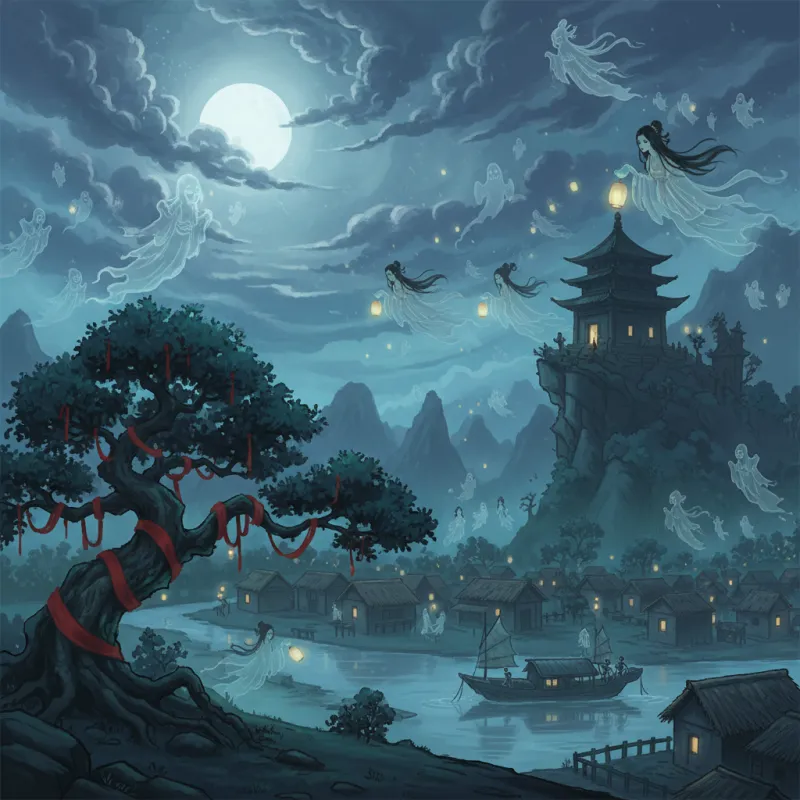
The scholar's scream died in his throat as he watched the creature peel off its face like a silk robe, revealing the rotting flesh beneath. This scene from "The Painted Skin" (画皮, huàpí) isn't just horror for horror's sake — it's a 300-year-old warning about lust, vanity, and the consequences of ignoring your wife's intuition.
Why Chinese Ghost Stories Hit Different
Chinese ghost stories don't play by Western rules. In Hollywood horror, ghosts are usually the problem. In Chinese folklore, ghosts are usually the consequence. The real horror happened before the ghost showed up — betrayal, greed, injustice, or in many cases, really bad judgment calls by men who should've known better.
This moral framework goes back to the Shanhaijing (山海经, Shānhǎijīng) — the "Classic of Mountains and Seas" compiled around the 4th century BCE. Even then, supernatural encounters weren't random. They reflected cosmic balance, karmic debt, and the thin membrane between the living world and the realm of hungry ghosts. By the Qing Dynasty, when Pu Songling (蒲松龄) wrote Liaozhai Zhiyi (聊斋志异, Strange Tales from a Chinese Studio) in the 1670s, this tradition had crystallized into something profound: ghost stories as moral philosophy wrapped in genuine terror.
The Painted Skin: A Masterclass in Ignoring Red Flags
Let's return to that scholar, Wang Sheng (王生), because his story is a perfect example of how Chinese ghost stories work. He meets a beautiful woman on the road who claims she's fleeing an abusive situation. Does he help her find shelter? No. He brings her home and installs her as his mistress. His wife notices something's off immediately — women in these stories always do — but Wang Sheng is too smitten to listen.
Enter a Daoist priest who takes one look at the "woman" and warns Wang that he's harboring a demon. Wang dismisses him. That night, curiosity finally overcomes lust, and Wang peeks through his guest's window. What he sees will haunt you: a green-faced demon with jagged teeth, hunched over a human skin spread on the bed like a dress pattern, carefully painting features onto it with a brush.
The demon catches him looking. By morning, Wang Sheng is dead, his heart ripped from his chest.
Here's what makes this story brilliant: the demon isn't the villain. Wang's arrogance is. His wife has to debase herself — literally begging a madman to spit in her face so she can use his saliva to resurrect her husband — because Wang couldn't control his desires or respect her judgment. The painted skin isn't just a disguise; it's a metaphor for surface beauty hiding moral rot. And that rot was in Wang all along.
The Woman in the Wall: When Revenge Becomes Architecture
Not all Chinese ghosts are demons in disguise. Some are victims who refuse to stay buried. The story of the woman sealed alive in a wall appears in multiple variations across Chinese folklore, but the core remains consistent: a wealthy family murders a servant or concubine (usually for knowing too much or rejecting the master's advances) and bricks her body into a wall during construction.
Years later, the house becomes uninhabitable. Footsteps echo from inside the walls. A woman's weeping keeps the family awake. Objects move. Children fall ill. The family brings in Buddhist monks, Daoist priests, even Confucian scholars to perform exorcisms, but nothing works. The ghost isn't there to be exorcised — she's there to be acknowledged.
These stories reflect real anxieties about Chinese burial practices and the treatment of servants in imperial China. A proper burial with regular offerings ensures the dead rest peacefully. Deny someone that dignity, and you've created a yuānhún (冤魂) — a wronged ghost with legitimate grievances. The only solution is confession, restitution, and proper burial rites. You can't negotiate with karma.
The Scholar and the Fox Spirit: Interspecies Romance Gone Wrong
Fox spirits (húlijīng, 狐狸精) occupy a unique space in Chinese supernatural taxonomy — they're not quite ghosts, not quite demons, and occasionally not even evil. After cultivating their powers for centuries, foxes can transform into beautiful women (or occasionally men) and interact with humans. Sometimes they're seductresses who drain men's life force. Sometimes they're faithful lovers who save their human partners from disaster.
The ambiguity is the point. In Liaozhai Zhiyi, Pu Songling wrote dozens of fox spirit stories, and they're rarely straightforward. One tale features a scholar who falls in love with a fox woman, only to discover she's been protecting him from a real demon the entire time. Another shows a fox spirit who genuinely loves her human husband but must return to the spirit world when her true nature is revealed, leaving him heartbroken but alive.
These stories explore the danger and appeal of the exotic, the other, the unknowable. They ask: Can love transcend the boundary between human and spirit? Usually the answer is no, but the tragedy lies in how close it comes to being yes. Fox spirits represent temptation, but also the possibility that not all supernatural beings are enemies — some are just trying to navigate the same messy world of desire and consequence that humans inhabit.
The Hungry Ghost Festival: When the Veil Thins
Every year during the seventh lunar month, the gates of the underworld open and ghosts walk among the living. This is the Hungry Ghost Festival (Zhōngyuán Jié, 中元节), and it's when Chinese ghost stories stop being folklore and become lived experience for millions of people.
During this month, families leave food offerings on the street for wandering spirits who have no descendants to feed them. You don't swim — ghosts of drowning victims might pull you under to take your place. You don't whistle at night — it attracts unwanted attention. You don't pick up money on the ground — it might be ghost money, and taking it incurs a debt you can't repay.
This festival reveals something crucial about Chinese ghost stories: they're not separate from daily life. The supernatural isn't a distant threat in a haunted house on a hill. It's your neighbor, your ancestor, the person who died unjustly and now needs acknowledgment. Ghost stories are instructions for navigating a world where the dead are always present, always watching, always waiting for the living to fulfill their obligations.
The Jiangshi: China's Hopping Vampire
If you've seen Hong Kong horror comedies from the 1980s, you know the jiāngshī (僵尸) — the hopping vampire. Stiff-limbed corpses in Qing Dynasty official robes, arms outstretched, hopping because rigor mortis has locked their joints. They're often played for laughs now, but the original folklore is genuinely unsettling.
A jiangshi is created when a corpse is reanimated by unresolved grievances, improper burial, or possession by a restless spirit. Unlike Western vampires, they don't drink blood to survive — they absorb qì (气), the life force, through physical contact. They're blind but hunt by sensing the breath of living beings, which is why the classic defense is to hold your breath and stand perfectly still.
The jiangshi represents the ultimate failure of filial piety. In Chinese culture, caring for your parents' bodies after death is as important as caring for them in life. A jiangshi is what happens when that care is neglected — the body refuses to rest, becoming a mockery of the person it once was. It's horror rooted in social obligation, which makes it distinctly Chinese.
What Modern Horror Owes to Ancient Tales
When you watch contemporary Chinese horror films like The Eye or Rigor Mortis, you're seeing these ancient patterns play out with modern cinematography. The ghost isn't a random threat — it's the consequence of someone's actions. The protagonist can't just survive; they have to resolve the moral imbalance that created the haunting in the first place.
This is why Chinese ghost stories remain relevant. They're not about jump scares or gore (though they can include both). They're about accountability, justice, and the idea that actions have consequences that outlast death. In a world that often feels morally chaotic, these stories offer a strange comfort: the universe keeps score, and eventually, everyone pays their debts.
The scholar who ignored his wife's warnings, the wealthy family who murdered their servant, the son who neglected his parents' burial — they all learned the same lesson. In Chinese folklore, you can't outrun your karma. And the ghosts? They're just here to collect.
Related Reading
- The Most Famous Chinese Ghost Stories: Tales That Have Haunted a Civilization
- Ghost Stories from the Three Kingdoms: When Heroes Became Haunters
- Ghost Month: Surviving the Seventh Month
- Campus Ghost Stories in China: The Haunted Dormitories and Cursed Libraries
- The Ten Kings of Hell: A Complete Guide to Chinese Underworld Justice
- Modern Ghost Sightings in China: When Ancient Beliefs Meet the Digital Age
- Shamanism in Chinese Folk Religion: The Original Spirit Workers
Explore Chinese Culture
- Explore ancient mythical creatures
- Explore Daoist exorcism traditions
- Explore Chinese folk beliefs and superstitions