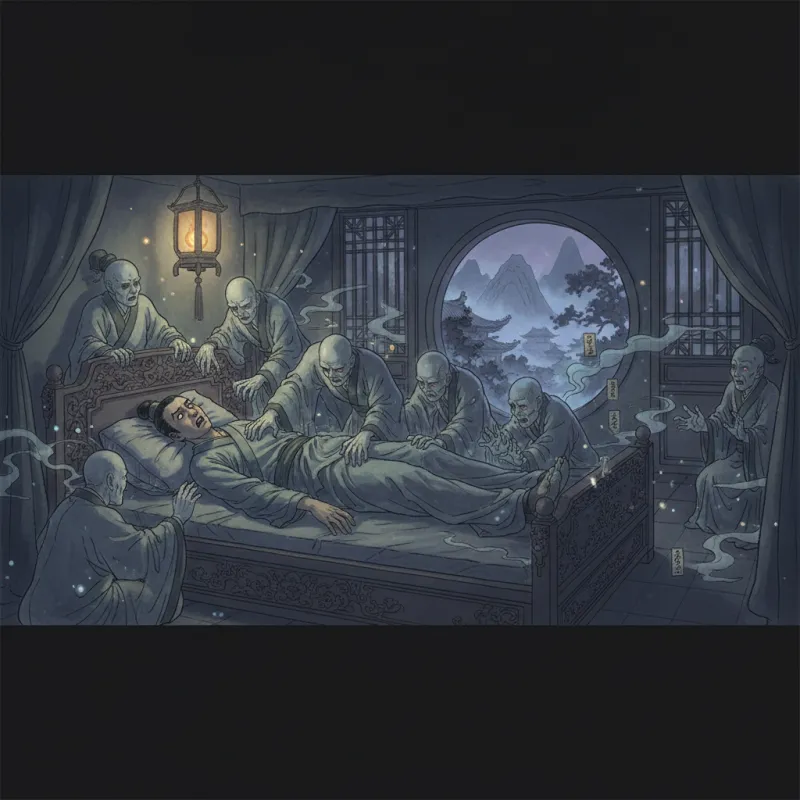
You wake in the dark. Your eyes snap open, but your body refuses to obey. A crushing weight pins your chest — not metaphorical, but physical, suffocating. You try to scream. Nothing. Your fingers won't curl. Your legs won't kick. And then you sense it: something in the room with you, watching from the shadows. Your rational mind knows this is impossible. Your body knows otherwise.
The Chinese have a name for this terror: 鬼压床 (guǐ yā chuáng), literally "ghost pressing bed." While Western medicine clinically labels this sleep paralysis — a neurological hiccup where consciousness returns before the body's REM-induced paralysis releases — traditional Chinese belief offers a more unsettling explanation. You're not experiencing a glitch in your sleep cycle. You're being attacked.
The Weight of the Dead
The term 鬼压床 appears throughout Chinese folklore and medical texts, though its interpretation has shifted across dynasties. In the Ming Dynasty compendium Bencao Gangmu (本草纲目, 1578), physician Li Shizhen documented cases of "ghost pressing" alongside other nocturnal afflictions, attributing them to imbalances in qi and blood flow. But folk tradition tells a darker story.
According to popular belief, 鬼压床 occurs when a wandering spirit — often a hungry ghost (饿鬼, è guǐ) or the restless dead — sits on a sleeping person's chest. These entities are drawn to the vulnerable: those who sleep in inauspicious positions, who've recently attended funerals, or who've inadvertently offended the spirit world. The ghost feeds on the sleeper's yang energy (阳气, yáng qì), leaving them paralyzed and terrified.
The physical sensation matches the folklore eerily well. Sleep paralysis sufferers consistently report pressure on the chest, difficulty breathing, and the overwhelming sense of a malevolent presence. Some see shadowy figures. Others hear whispers or footsteps. The experience is so visceral that even skeptics find themselves questioning their rationality in the moment.
Who Gets Pressed and Why
Traditional Chinese medicine identifies several risk factors for 鬼压床, many of which align surprisingly well with modern sleep science. Sleeping on your back (仰卧, yǎng wò) is considered particularly dangerous — the supine position supposedly makes it easier for spirits to settle on your chest. Western research confirms that back-sleeping significantly increases sleep paralysis frequency, though the mechanism involves airway restriction and altered REM patterns rather than spectral visitors.
Exhaustion and irregular sleep schedules also invite ghost pressing. Students preparing for imperial examinations were historically prone to these episodes, as are modern students facing exam stress. The Chinese explanation: depleted yang energy creates spiritual vulnerability. The scientific explanation: sleep deprivation and stress disrupt normal sleep architecture, causing REM intrusion into wakefulness. Different frameworks, same outcome.
Certain locations carry higher risk. Sleeping in unfamiliar places, particularly old buildings or rooms where someone died, supposedly attracts unwanted spiritual attention. This belief persists strongly enough that many Chinese people avoid sleeping in hospital rooms or funeral homes even when exhausted. Whether this reflects genuine supernatural danger or psychological priming that triggers anxiety-induced sleep paralysis remains debatable.
The Nightmare Hag Across Cultures
China isn't alone in attributing sleep paralysis to supernatural assault. The phenomenon appears in folklore worldwide, each culture dressing the experience in local supernatural garb. In Newfoundland, the "Old Hag" sits on sleepers' chests. In Japan, 金縛り (kanashibari, "bound in metal") was traditionally blamed on vengeful spirits. The Hmong community calls it dab tsog, believing a crushing spirit causes sudden nocturnal death syndrome.
What's striking is the consistency of the experience across cultures: the pressure, the presence, the paralysis. This universality suggests sleep paralysis taps into something fundamental in human neurology — perhaps an evolutionary alarm system misfiring, interpreting the body's paralyzed state as predatory threat. Our ancestors who woke to genuine danger (a predator in the cave) and couldn't move would be rightfully terrified. The brain, detecting paralysis, generates the threat to match the fear.
But this neurological explanation doesn't fully capture why the experience feels so specifically malevolent. Sleep paralysis isn't just scary — it feels intentionally hostile, as if something wants to harm you. The Chinese concept of 鬼压床 acknowledges this quality in a way clinical terminology doesn't. Whether you believe in literal ghosts or not, the phenomenology of the experience demands recognition.
Breaking Free: Traditional Remedies
Chinese folk tradition offers various methods to prevent or escape 鬼压床. Some are practical, others decidedly supernatural. Sleeping with a pair of scissors under your pillow supposedly cuts through spiritual attacks — the metal's yang energy repels yin entities. Placing a broom beside the bed serves similar protective function, as ghosts must count every bristle before attacking, keeping them occupied until dawn.
More active resistance involves mental techniques. Experienced sufferers recommend focusing on moving a single body part — typically a finger or toe — to break the paralysis. This advice actually aligns with modern sleep paralysis management strategies, which suggest concentrating on small movements to accelerate the transition to full wakefulness. Whether you're fighting a ghost or a neurological state, the technique works.
Religious protection plays a major role. Taoist talismans (符, fú) placed above the bed ward off malevolent spirits. Buddhist practitioners recite protective mantras like the Great Compassion Mantra (大悲咒, Dàbēi Zhòu) before sleep. Even non-religious families might keep a small mirror facing the bedroom door — spirits supposedly see their own reflection and flee. These practices provide psychological comfort that may reduce anxiety-related sleep paralysis, regardless of their supernatural efficacy.
The Medical Reality Behind the Myth
Modern sleep medicine has thoroughly documented sleep paralysis, identifying it as a REM parasomnia where consciousness returns before motor control. During REM sleep, the brainstem paralyzes voluntary muscles to prevent dream enactment. Normally, this paralysis releases before or simultaneously with awakening. In sleep paralysis, the timing fails — you wake up trapped in your immobilized body.
The hallucinations accompanying sleep paralysis stem from REM dream imagery bleeding into waking consciousness. The sense of presence, the shadowy figures, the feeling of being watched — these are dream elements your conscious mind experiences as real. The chest pressure likely results from restricted breathing during REM combined with anxiety-induced hyperventilation attempts.
Risk factors include sleep deprivation, irregular sleep schedules, sleeping supine, stress, and certain medications. Narcolepsy patients experience sleep paralysis frequently, as their REM regulation is fundamentally disrupted. The condition is harmless physically, though psychologically distressing. Most episodes last seconds to minutes, though they feel much longer.
Yet knowing the mechanism doesn't diminish the terror. You can understand intellectually that you're experiencing a neurological phenomenon while simultaneously feeling absolute certainty that something malevolent is in the room. This disconnect between knowledge and experience is what makes sleep paralysis so uniquely disturbing — and why supernatural explanations persist despite scientific understanding.
When Science and Folklore Converge
The fascinating aspect of 鬼压床 isn't whether ghosts literally press on sleeping people — it's how traditional Chinese understanding captured genuine patterns that modern science later confirmed. The emphasis on sleep position, exhaustion, and psychological state as risk factors demonstrates sophisticated observation, even if the explanatory framework differs from contemporary neurology.
Consider the connection between funeral attendance and nightmares in Chinese tradition. People who've recently attended funerals are warned about increased 鬼压床 risk. Scientifically, grief and death-related anxiety disrupt sleep architecture, making parasomnia more likely. The folk belief and the medical reality describe the same phenomenon from different angles.
Similarly, the Chinese concept of depleted yang energy inviting spiritual attack parallels the modern understanding of how stress and exhaustion compromise normal sleep regulation. When traditional medicine recommends strengthening yang through rest, proper diet, and stress reduction, it's prescribing exactly what sleep specialists would recommend for parasomnia prevention — just using different terminology.
This convergence suggests that dismissing traditional beliefs as mere superstition misses something important. Folk knowledge often encodes practical wisdom in supernatural language. Whether you believe a ghost is literally sitting on your chest or your brainstem is misfiring, the experience is real, the terror is genuine, and the coping strategies often work regardless of your explanatory framework.
Living With the Ghost Press
For those who experience 鬼压床 regularly, the question isn't whether ghosts are real — it's how to sleep without fear. Some sufferers adopt traditional protective measures: the scissors, the talismans, the careful attention to sleep position. Others pursue medical intervention: improved sleep hygiene, stress management, sometimes medication for underlying conditions.
The most effective approach might combine both frameworks. Maintain regular sleep schedules and reduce stress (medical advice). Sleep on your side rather than your back (both traditional and modern recommendation). Keep protective symbols nearby if they provide psychological comfort (traditional practice that reduces anxiety). Focus on moving a finger to break paralysis (technique that works whether you're fighting ghosts or neurology).
What matters is acknowledging the experience's reality without letting fear dominate your nights. Sleep paralysis is common, usually harmless, and manageable. Whether you conceptualize it as 鬼压床 or REM intrusion, you're not crazy, you're not alone, and you're not actually in danger — though try telling that to your terrified brain at 3 AM when something invisible is crushing your chest.
The next time you wake paralyzed with a presence in the room, remember: millions of people across centuries have experienced exactly this. Some called it ghost pressing. Some call it sleep paralysis. All of them survived to wake fully, move freely, and tell the tale. The ghost — or the glitch — always releases its grip eventually. You just have to wait it out, one frozen breath at a time.
Related Reading
- Dream Spirits and Sleep Demons: The Supernatural World of Chinese Dreams
- Dream Interpretation in Chinese Culture: When the Spirit Wanders at Night
- Chinese Dream Interpretation: What Your Dreams Mean in Traditional Culture
- Soul Travel in Chinese Belief: When Your Spirit Leaves Your Body During Sleep
- Exploring the Multifaceted World of Chinese Supernatural Folklore and Afterlife Beliefs
- What is Liaozhai Zhiyi? A Guide to China's Greatest Ghost Stories
- Exploring Chinese Supernatural Folklore: The Haunting World of Ghosts and Spirits
Explore Chinese Culture
- Explore ancient mythical creatures
- Explore Daoist exorcism traditions
- Explore Chinese folk beliefs and superstitions