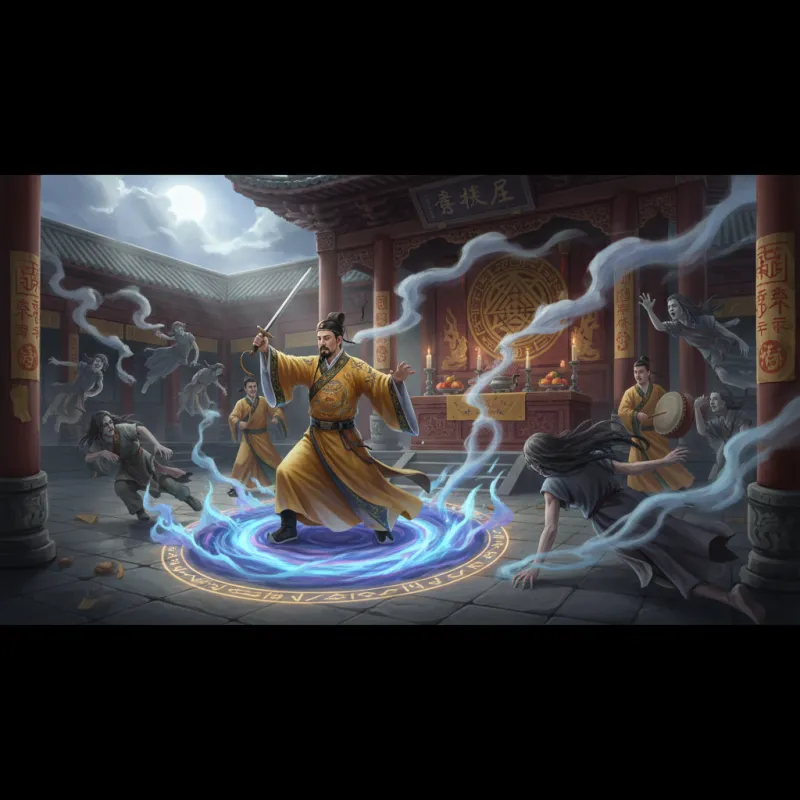
The old woman wouldn't leave her bedroom. For three nights, she'd heard scratching inside the walls — not mice, she insisted, but fingernails. Her daughter called a Daoist priest. He arrived with a wooden sword, a bag of yellow paper, and a brush still wet with cinnabar ink. Twenty minutes later, he walked out, folded three hundred yuan into his pocket, and told them the ghost was gone. The scratching stopped that night.
This is how exorcism works in Chinese tradition: practical, transactional, and surprisingly common. Ghosts aren't metaphors for trauma or symbols of the unconscious — they're real problems requiring real solutions. And Chinese culture has developed an entire infrastructure for dealing with them.
The Daoist Priest: Professional Ghost Removal
The Daoist priest (道士, dàoshì) is China's equivalent of a licensed contractor, except he works in the supernatural realm. His training is formal, his methods are standardized, and his fees are negotiable.
His primary tool is the talisman (符, fú) — yellow paper inscribed with red cinnabar characters in a specialized script called 符文 (fúwén). These aren't decorative. Each talisman is a command written in the bureaucratic language of the spirit world, invoking specific deities and cosmic forces. The most common is the 五雷符 (wǔléi fú), the Five Thunder Talisman, which calls down celestial lightning to obliterate malevolent spirits.
Talismans are deployed three ways: burned (sending the command directly to the heavens), pasted on doors or walls (creating a barrier), or carried on the body (personal protection). A skilled priest can write a talisman in seconds, the brush moving in practiced strokes that look like calligraphy but function like code.
The second tool is the 桃木剑 (táomù jiàn), the peachwood sword. Peach wood has been considered spiritually potent since at least the Han Dynasty — it's mentioned in the Lunheng (论衡) by Wang Chong as a material that "subdues evil influences." The sword isn't sharp. It doesn't need to be. It channels the priest's spiritual authority, and when swung through the air in ritual patterns, it cuts through the invisible threads that bind ghosts to the physical world.
Then there's the 八卦镜 (bāguà jìng), the bagua mirror — a small octagonal mirror surrounded by the eight trigrams of the I Ching. Hung above a doorway, it reflects negative energy back to its source. This is defensive exorcism: you're not destroying the ghost, just making your home an unpleasant place for it to linger.
The Buddhist Monk: Compassionate Exorcism
Buddhist monks (和尚, héshang) take a different approach. They don't destroy ghosts — they liberate them.
In Buddhist cosmology, ghosts are 饿鬼 (èguǐ), hungry ghosts, trapped in a realm of suffering by their own attachments and desires. The monk's job isn't to banish them but to guide them toward rebirth in a better realm. This is done through 超度 (chāodù), a ritual that literally means "to transcend and cross over."
The most powerful version is the 水陆法会 (shuǐlù fǎhuì), the Water and Land Dharma Assembly, a multi-day ceremony that feeds and blesses all wandering spirits in the area. It's expensive — temples charge tens of thousands of yuan — but it's comprehensive. You're not just dealing with one ghost; you're clearing the entire spiritual neighborhood.
For smaller hauntings, a monk might simply chant the 大悲咒 (Dàbēi Zhòu), the Great Compassion Mantra, or the 心经 (Xīnjīng), the Heart Sutra. The sound vibrations are believed to calm restless spirits and remind them of the path to enlightenment. It's gentler than Daoist methods, and some families prefer it — especially if the ghost is a deceased relative who deserves respect rather than violence.
DIY Exorcism: Folk Methods
Not every haunting requires a professional. Chinese folk tradition is full of home remedies for minor ghost problems, passed down through generations like recipes for cold medicine.
Glutinous rice (糯米, nuòmǐ) is the most famous. Scatter it around your home's perimeter, and ghosts supposedly can't cross the line. Why rice? The explanations vary — some say its purity repels impurity, others claim it's because rice is a life-giving food and ghosts are death-aligned. In the 1985 film Mr. Vampire, the Daoist priest uses glutinous rice to draw poison from a vampire bite, cementing its place in popular ghost-fighting lore.
Black dog blood (黑狗血, hēi gǒu xuè) is more extreme. Smear it on your doorframe, and you've created a barrier that even powerful ghosts hesitate to cross. This method appears in Strange Tales from a Chinese Studio (聊斋志异), where it's used to protect against fox spirits and demons. The logic: black dogs can see ghosts, so their blood carries anti-ghost properties. It's messy, ethically questionable, and increasingly rare in modern practice.
Firecrackers (鞭炮, biānpào) serve double duty — they scare away ghosts and announce your refusal to be intimidated. The loud noise disrupts spiritual energy, and the sulfur smoke is considered purifying. This is why firecrackers are set off during Chinese New Year and funerals: you're clearing the space of lingering spirits.
For those interested in the broader context of protective practices, see Chinese Ghost Protection Methods.
When Exorcism Fails: The Dangerous Cases
Some ghosts don't respond to standard methods. These are the 厉鬼 (lìguǐ), fierce ghosts — spirits who died violently or unjustly and carry grudges that transcend normal spiritual rules.
In these cases, you need a specialist. The 茅山道士 (Máoshān dàoshì), priests trained in the Maoshan tradition, are known for handling the worst hauntings. Their techniques are more aggressive: binding spells that trap ghosts in containers, exorcism rituals that involve blood sacrifice, and talismans so powerful they're dangerous to write incorrectly.
The most extreme method is 镇压 (zhènyā), suppression — burying a cursed object or talisman at the haunting site to pin the ghost down permanently. This doesn't free the spirit; it imprisons it. It's a last resort, used when the ghost is too dangerous to release and too powerful to destroy.
There's also the nuclear option: calling in a 天师 (tiānshī), a Celestial Master, the highest rank of Daoist priest. These are rare, expensive, and usually only involved when an entire village is affected. The Celestial Master can petition the Jade Emperor himself to intervene, essentially escalating the case to heaven's supreme court.
The Modern Exorcism Industry
Exorcism hasn't disappeared in contemporary China — it's adapted. In cities like Hong Kong, Taiwan, and Singapore, Daoist temples offer exorcism services with price lists posted online. A basic house blessing costs a few hundred yuan. A full exorcism with multiple priests and a multi-hour ritual can run into the thousands.
Some priests have gone digital. You can buy talismans on Taobao, though their effectiveness is debated. Video call exorcisms became popular during COVID-19 lockdowns — the priest performs the ritual remotely while you follow instructions at home. Traditionalists are skeptical, but desperate people will try anything.
The government's position is complicated. Officially, superstition is discouraged. Practically, exorcism is tolerated as "intangible cultural heritage." Temples operate openly, and during Ghost Month (the seventh lunar month), exorcism services are in high demand.
The Psychology of Exorcism
Western observers often dismiss Chinese exorcism as superstition, but that misses the point. Whether ghosts are "real" in a scientific sense is irrelevant — the rituals work because they provide psychological closure and community validation of suffering.
When a Daoist priest performs an exorcism, he's not just waving a sword at invisible entities. He's giving the family a narrative framework for their fear, a concrete action to take against helplessness, and an authority figure who confirms that their experience is real and solvable. The ritual creates a before and after, a clear moment when the problem was addressed.
This is why exorcism persists. It's not about belief in ghosts — it's about belief in solutions. And in a culture where the boundary between the living and the dead has always been permeable, having a professional who can manage that boundary provides genuine comfort.
For more on the types of spirits that require exorcism, see Chinese Ghost Types and Classifications.
Choosing Your Exorcist
If you find yourself needing an exorcism (hypothetically speaking), here's the practical guide:
For minor hauntings — strange noises, cold spots, bad luck — try folk methods first. Glutinous rice, firecrackers, and a bagua mirror cost almost nothing and might solve the problem.
For persistent hauntings — apparitions, physical disturbances, illness — call a local Daoist priest. Ask for references, check how long they've been practicing, and get a price quote upfront. A legitimate priest will assess the situation before naming a fee.
For hauntings involving deceased relatives — consider a Buddhist monk instead. The compassionate approach is more appropriate when you're dealing with family, and the ritual provides closure for the living as much as liberation for the dead.
For dangerous hauntings — violent phenomena, possession, multiple witnesses — find a Maoshan specialist or Celestial Master. Don't cheap out. This is not the time for DIY solutions or inexperienced practitioners.
And if all else fails, move. Sometimes the most effective exorcism is simply leaving the ghost behind.
Related Reading
- Daoist Exorcism Rituals Explained: How to Kick Out a Demon the Chinese Way
- Talismans and Fu: The Ancient Art of Paper Magic
- Zhong Kui: The Demon Queller Who Failed His Exams
- Modern Exorcism in Chinese Communities: When Ancient Rituals Meet the 21st Century
- Chinese Funerals: A Complete Guide to Death Customs and Rituals
- Liaozhai Zhiyi: The Ghost Stories That Changed Chinese Literature
- How Animals Become Demons: The Yaoguai Transformation Process
Explore Chinese Culture
- Explore ancient mythical creatures
- Explore Daoist exorcism traditions
- Explore Chinese folk beliefs and superstitions