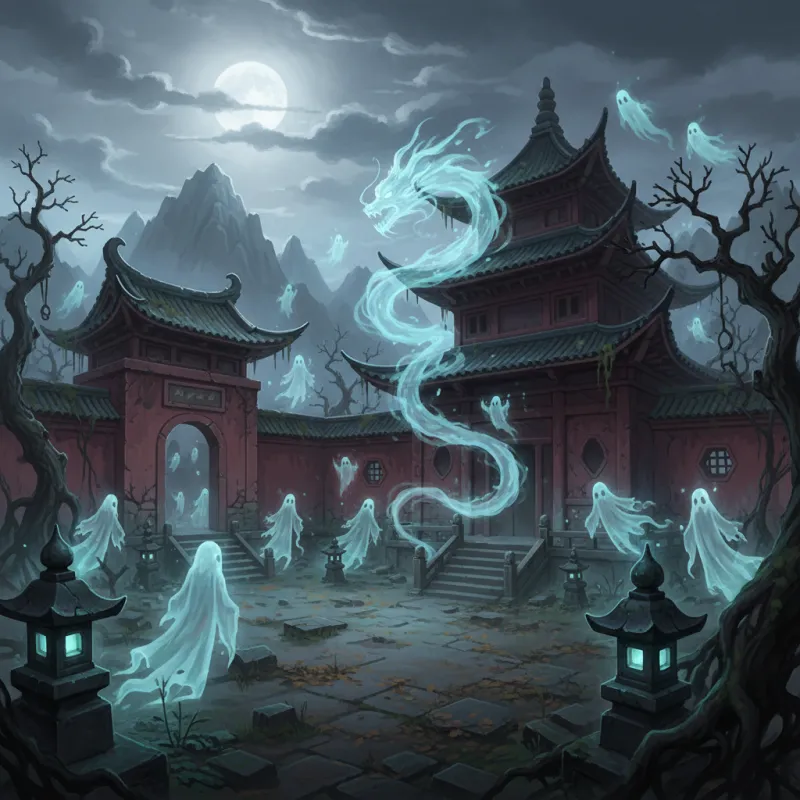
Haunted Temples of China: Sacred Meets Supernatural
China's ancient temples stand as architectural marvels where incense smoke curls toward heaven and prayers echo through centuries-old halls. Yet beneath their sacred purpose lies another dimension—one where restless spirits wander, supernatural guardians patrol, and the boundary between the living and dead grows thin. These haunted temples represent a fascinating intersection of Buddhist and Taoist spirituality with China's rich tradition of ghost lore, creating spaces that are simultaneously revered and feared.
The Spiritual Architecture of Fear
Chinese temples were never designed merely as places of worship. Their layout follows principles of fengshui (风水, fēngshuǐ)—the ancient art of harmonizing human structures with cosmic forces. Ironically, this same spiritual potency that makes temples powerful centers of divine energy also attracts supernatural entities. The concept of lingqi (灵气, língqì), or spiritual energy, flows through these sacred spaces, drawing both benevolent deities and malevolent spirits.
Temple architecture itself creates an atmosphere conducive to supernatural encounters. Dark corridors lit only by flickering butter lamps, shadowy courtyards where ancient trees cast gnarled silhouettes, and meditation halls where silence amplifies every creak and whisper—these elements combine to blur the line between psychological suggestion and genuine paranormal activity. The daxiongbaodian (大雄宝殿, dàxióngbǎodiàn), or Great Hero's Treasure Hall, often serves as the epicenter of supernatural reports, perhaps because it houses the most powerful Buddhist icons and thus attracts the most intense spiritual activity.
Fayuan Temple: Beijing's Repository of Restless Souls
Located in Beijing's Xuanwu District, Fayuan Si (法源寺, Fǎyuán Sì), or the Temple of the Source of Dharma, holds the distinction of being the oldest temple in the capital, founded in 645 CE. Its ancient halls have witnessed over thirteen centuries of history, including countless deaths, political purges, and violent upheavals. Monks and visitors report encountering youhun (游魂, yóuhún)—wandering souls—particularly in the temple's rear courtyards after dusk.
The most frequently reported phenomenon involves the sound of chanting emanating from empty halls. Witnesses describe hearing the rhythmic recitation of Buddhist sutras, specifically the Xinjing (心经, Xīnjīng), or Heart Sutra, coming from the main prayer hall long after the temple has closed. When investigated, the hall stands empty, with only the faint scent of sandalwood lingering in the air. Some Buddhist scholars suggest these are yinsheng (阴声, yīnshēng)—yin sounds—echoes of prayers so powerful they've imprinted themselves on the spiritual fabric of the location.
Temple records mention a particularly tragic incident during the Cultural Revolution when Red Guards desecrated the temple. Several monks who tried to protect sacred texts were beaten to death in the courtyard. Since then, visitors have reported seeing shadowy figures in traditional monastic robes moving through that specific area, always at twilight. These apparitions never acknowledge the living, continuing their eternal vigil over texts that no longer exist in physical form.
The White Cloud Temple: Where Immortals and Ghosts Converge
Baiyun Guan (白云观, Báiyún Guān), Beijing's White Cloud Temple, serves as the headquarters of the Quanzhen School of Taoism. As one of China's most important Taoist centers, it attracts not only devotees seeking spiritual cultivation but also supernatural entities drawn to its concentrated daoli (道力, dàolì)—Taoist power. The temple's reputation for paranormal activity stems from its dual function as both a place of worship and a site for chaodu (超度, chāodù) rituals—ceremonies to help deceased souls transcend to the afterlife.
The temple's Yuhuang Ge (玉皇阁, Yùhuáng Gé), or Jade Emperor Pavilion, stands three stories tall and houses images of the supreme Taoist deity. Temple guardians report that on certain nights, particularly during the Zhongyuan Jie (中元节, Zhōngyuán Jié), or Ghost Festival, the pavilion becomes a gathering place for spirits. Witnesses describe seeing translucent figures ascending the stairs, as if queuing to petition the Jade Emperor. These spirits appear dressed in clothing from various dynasties, suggesting they've been waiting for centuries.
One particularly well-documented case involves a Taoist priest who, in the 1990s, encountered what he described as a guixian (鬼仙, guǐxiān)—a ghost immortal. According to his account, while performing late-night meditation in the Hall of the Four Celestial Emperors, he observed an elderly figure in archaic Taoist robes materialize before the altar. The figure performed a complete ritual sequence with perfect precision, then turned to the priest and spoke a single sentence in classical Chinese: "The way is eternal; the form is temporary." The apparition then dissipated like morning mist. Research into temple archives revealed that the description matched a renowned Taoist master who had died in that very hall during the Qing Dynasty.
Lingyin Temple: Hangzhou's Haunted Buddhist Sanctuary
Nestled in the lush hills west of Hangzhou's West Lake, Lingyin Si (灵隐寺, Língyǐn Sì), the Temple of the Soul's Retreat, ranks among China's most important Chan (Zen) Buddhist monasteries. Founded in 328 CE, the temple complex sprawls across the forested mountainside, incorporating natural caves filled with ancient Buddhist carvings. This integration of natural and constructed sacred space creates numerous locations where supernatural encounters occur.
The Feilai Feng (飞来峰, Fēilái Fēng), or Peak That Flew Here, stands opposite the main temple and contains over 300 stone Buddhist sculptures carved into its limestone cliffs. Local legend claims the peak literally flew from India, carrying with it not only Buddhist iconography but also spiritual entities. Visitors frequently report feeling watched while walking among these ancient carvings, and photographs taken in the area often reveal unexplained orbs of light or shadow figures that weren't visible to the naked eye.
The temple's most haunting location is the Dabei Lou (大悲楼, Dàbēi Lóu), or Hall of Great Compassion, which houses a magnificent statue of Guanyin Pusa (观音菩萨, Guānyīn Púsà), the Bodhisattva of Compassion. Temple monks maintain that Guanyin's presence is so powerful that suffering spirits are drawn to the hall seeking relief. On multiple occasions, visitors have reported seeing a woman in white robes kneeling before the statue, weeping silently. When approached, she vanishes. Monks interpret these sightings as manifestations of kugui (苦鬼, kǔguǐ)—suffering ghosts—drawn to Guanyin's compassionate energy.
One particularly compelling account comes from a temple volunteer who spent a night in meditation near the hall. She described hearing the sound of a woman sobbing, followed by a gentle, feminine voice speaking words of comfort. The sobbing gradually ceased, replaced by a profound silence. The volunteer interpreted this as witnessing Guanyin's intervention in helping a troubled spirit find peace—a direct manifestation of the bodhisattva's vow to relieve all suffering.
The Lama Temple: Tibetan Buddhism's Haunted Outpost
Beijing's Yonghegong (雍和宫, Yōnghégōng), commonly known as the Lama Temple, represents Tibetan Buddhism's most important monastery outside Tibet. Originally a Qing Dynasty prince's mansion that later became Emperor Yongzheng's residence before his ascension to the throne, the complex carries the spiritual weight of both imperial history and Tibetan Buddhist practice. This dual heritage creates a unique supernatural atmosphere.
The temple's most famous haunting involves the Wanfu Ge (万福阁, Wànfú Gé), or Tower of Ten Thousand Happinesses, which houses an 18-meter tall statue of Maitreya Buddha carved from a single piece of white sandalwood. Guards and monks report that the statue's eyes appear to move, following visitors through the hall. More unsettling are reports of a presence that manifests as a sudden, overwhelming feeling of being judged. Tibetan Buddhist practitioners explain this as an encounter with dharmapalas (护法, hùfǎ)—wrathful protective deities—who guard the temple against negative influences.
The temple's history includes a dark period during the Qing Dynasty when it served as a site for political intrigue and assassination. Several princes and officials met mysterious deaths within its walls. Their restless spirits, according to temple lore, remain bound to the location. Visitors have reported encountering a figure in imperial robes wandering the corridors connecting the various halls, always moving toward the former residential quarters. This apparition never acknowledges the living and passes through locked doors as if they don't exist.
Tibetan monks at the temple perform regular sang (桑, sāng) purification rituals, burning juniper and other sacred herbs to cleanse the space of negative spiritual influences. Despite these efforts, supernatural activity persists, suggesting that some entities are either too powerful to be expelled or are actually serving as spiritual guardians rather than malevolent haunts.
Understanding Temple Hauntings: The Chinese Perspective
Chinese supernatural philosophy offers a sophisticated framework for understanding why temples become haunted. Unlike Western ghost stories that often frame hauntings as purely negative phenomena, Chinese tradition recognizes multiple categories of spiritual presence in sacred spaces.
Shengui (善鬼, shànguǐ), or benevolent ghosts, may linger in temples because they've achieved a degree of spiritual cultivation but haven't yet transcended to the next realm. These entities often serve as informal guardians, protecting the temple and its inhabitants. Monks sometimes report receiving warnings about impending danger from unseen presences, or finding that vandals and thieves are mysteriously deterred from entering certain areas.
Conversely, egui (恶鬼, èguǐ), or malevolent ghosts, may be drawn to temples precisely because of the concentrated spiritual energy, which they seek to corrupt or consume. These entities typically manifest as feelings of dread, sudden illness, or aggressive phenomena like objects being thrown. Temple masters combat such presences through fazhu (法术, fǎzhú)—ritual magic—and the continuous recitation of protective sutras.
The concept of yinyuan (因缘, yīnyuán), or karmic connection, also plays a crucial role. Some spirits appear in temples because they have unfinished karmic business with the location, the deities worshipped there, or even specific individuals who visit. These hauntings often resolve once the karmic debt is addressed through appropriate rituals or actions.
The Role of Ritual in Managing Supernatural Presence
Chinese temples don't simply accept hauntings passively. Both Buddhist and Taoist traditions maintain elaborate ritual systems for managing supernatural entities. The shuilu fahui (水陆法会, shuǐlù fǎhuì), or Water and Land Dharma Assembly, represents one of Buddhism's most comprehensive rituals for addressing spiritual disturbances. This multi-day ceremony invites all beings—from the highest celestial deities to the lowest suffering ghosts—to receive Buddhist teachings and offerings.
Taoist temples employ jiao (醮, jiào) rituals, elaborate ceremonies that petition celestial bureaucracies to intervene in supernatural matters. These rituals recognize that the spirit world operates according to hierarchical principles similar to imperial China's governmental structure. By filing the proper spiritual "paperwork" and making appropriate offerings, Taoist priests can request that troublesome spirits be reassigned to other locations or helped to move on to their next incarnation.
Conclusion: The Living Tradition
China's haunted temples remain active religious sites, not abandoned ruins. This ongoing spiritual practice creates a dynamic relationship between the living and the dead, the sacred and the supernatural. Monks continue their daily routines of prayer and meditation, visitors seek blessings and guidance, and spirits—whether guardian or ghost—maintain their mysterious presence.
These temples remind us that in Chinese cosmology, the supernatural isn't separate from the sacred but intimately intertwined with it. The same spiritual power that makes a temple holy also makes it haunted. The incense that carries prayers to heaven also attracts wandering souls. The meditation that brings enlightenment also opens perception to other realms.
For those who visit these ancient sites, the experience offers more than historical tourism. It provides a glimpse into a worldview where multiple dimensions of existence overlap, where the past remains present, and where the boundary between the living and the dead is not a wall but a permeable membrane. Whether one encounters actual spirits or simply feels the weight of centuries of accumulated spiritual energy, China's haunted temples continue to serve their original purpose: reminding us that reality extends far beyond what we can see with ordinary eyes.